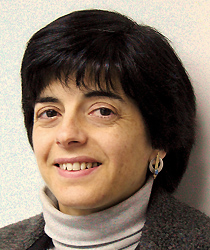
Salamanca-Riba, Lourdes G.
Maryland Energy Innovation Institute
EDUCATION
Ph.D., Massachusetts Institute of Technology (MIT), 1985
PROFESSIONAL MEMBERSHIPS
- American Physical Society (APS)
- Electron Microscopy Society of America
-
Materials Research Society (MRS)
Learn about Dr. Salamanca-Riba's current study of Nanocarbon-metal composites in this DOE fact sheet (PDF).
Dr. Salamanca-Riba typically teaches the following courses:
ENMA 671: Defects in Materials
This course emphasizes fundamental aspects of zero-, one- and two-dimensional defects in materials. The thermodynamic equilibrium of point defects in different oxide materials and their effect on the physical properties of the material are discussed. Dislocation-dislocation and dislocation-point defect interactions, dislocations in different crystals and roles of dislocations in deformation, twinning, and phase transformation are also discussed. The effects of dislocations and other defects on the electrical, optical, thermal and mechanical properties of materials are discussed.
ENMA 680: Experimental Methods in Materials Science
This course covers the basic principles of electron microscopy theory, electron diffraction, and imaging theory. The electron beam sample interaction that gives rise to different signals is related to the structural and compositional information that is obtained from a sample using a TEM. The most common TEM techniques for structural characterization of a sample, namely, electron diffraction, bright/dark field imaging, and high resolution lattice imaging are discussed. Compositional information obtained from x-ray fluorescence and electron energy loss as well as the resolution of these techniques is also covered. A description of techniques used to study magnetic materials is also presented.
ENMA 683: Special Problems in Materials Science, Structural Determination Laboratory
This course covers the operation of an electron microscope. TEM techniques that are used to characterize the structure, defects, and composition of a sample are presented and used to study a variety of materials. These techniques are: electron diffraction patterns, bright/dark field imaging, high resolution lattice imaging and analytical microscopy techniques, such as, energy dispersive X-ray spectroscopy and electron energy loss spectroscopy. This course also covers different sample preparation techniques for TEM. The goal of the course is that the students become independent users of the TEM. The main objective in this class is to become an independent user of the TEM. This is achieved by learning:
- to align the beam in a transmission electron microscope
-
to operate the TEM by:
- tilting the sample to the desired orientation
- taking a diffraction pattern
- taking bright/dark field images
- how to analyze the images
- to obtain energy dispersive X-ray spectra and maps in TEM and STEM modes.
- to obtain high resolution lattice images
- to obtain and analyze electron energy loss spectra and maps in TEM and STEM modes