News Story
Learning From the Past, Innovating for the Future: Engineering Benefits from Indigenous Knowledge

Celebrate Native & Indigenous Engineers
From 19th century Erie Canal engineer Ely S. Parker, to one of NASA’s “hidden figures” Mary Ross, to the founder of Cummings Aerospace Sheila Cummings ’97, the Clark School celebrates the accomplishments of Native American and Indigenous voices in engineering, past and present. For Native and Indigenous Heritage Month this year, UMD’s Office of Multicultural Involvement and Community Advocacy (MICA) coordinated a calendar of campus-wide events open to all. Join in!
Other dedicated national, university, and Clark School resources include:
- American Indian Science and Engineering Society (AISES)
- Society for the Advancement of Chicanos/Hispanics and Native Americans in Science at UMD
- UMD’s Office of Multicultural Involvement and Community Advocacy (MICA) and its Native American and Indigenous Student Union
- Division of Student Affairs and its Unity Center, featuring cultural spaces including The Braid
- UMD Powwow
- Indigenous Futures Lab
- The Clark School’s CMSE
- Land Acknowledgement
How does traditional Indigenous knowledge benefit Marylanders today? How have Native and Indigenous practices and skills cultivated over many generations influenced engineering innovations? And how can today’s engineers learn from Indigenous knowledge to make a healthier, safer, and better future for all?
Maryland Engineering spoke with Piscataway tribal member and historian Mario Harley about the influence of Maryland’s Native population on society and engineering today, and more.
Maryland Engineering (ME): Mario, when you talk about your Indigenous ancestors engineering for the common good, you start with their observations of the world around them.
Harley: Indigenous innovations started with many years of observation of the environment around them. Everything began with the responsibility to protect the land and water of our home.
For instance, my ancestors in the Mid-Atlantic region would have understood that the large oyster reefs provided natural stormwater management and water filtration. The reefs were also a food source, a nursery for small animals, and a fishery. My ancestors utilized the gifts of the natural world, while working with it and maintaining it. Many of these advancements we continue to use today.
ME: Can you give us a few specific examples of how Native Americans innovated to their benefit—and to the benefit of their environment?
Harley: The Three Sisters companion growing method, the cable bridge, and the early kayak are a few common examples.
From an early agricultural perspective, the Three Sisters way of growing corn, beans, and squash together is very effective for crop development. It keeps out weeds and pests and provides maximum productivity with minimal effort. Here in the Mid-Atlantic, you could sustain yourself for an eight- to ninth-month period on the nearly 100 varieties of summer and winter squash grown by my ancestors in this way.
The foundation of cable bridges is braided cords. Today we use steel. But my ancestors would have observed that the strongest cords they could make included strips of cedar, as well as cattail and dogbane, which is water resistant.
The predecessor to our modern-day kayak, the canoe was predicated on decades of observation by my ancestors. The cypress—grown in marshy areas, making it water resistant and buoyant—was a strong choice of material. Colonists later over-harvested cypress for piers, barns, and fencing, so today it is relatively rare.
This kind of early engineering from the natural world aided in the ability for my ancestors to make their tools and methods better and stronger, for increased productivity and quality of life.
ME: You are a historian of the Piscataway people native to this region. Could you tell us about some Native innovations developed right in our university’s backyard?
Harley: There are some regional Indigenous innovations that have left evidence for us to see and study. The successful harvest of fish by the Piscataway people was critical, so they engineered fish hooks, of course.
They also engineered an effective, passive way of trapping fish. In Southern Maryland, they used small saplings dug into the soft river bottoms to create fishing weirs that would channel the fish into a circular pen for harvest. Above the tidal waters, the river bottoms become bedrock, so our ancestors created stone fishing weirs, and the remnants can still be seen today from Georgetown all the way up to Frederick.
Another innovation was the multi-family longhouse made from cedar saplings. In this region, the saplings were grown in productive groves for harvesting—something like our modern-day Home Depot—and were cut while they were still pliable. My ancestors tied the saplings into an arch-type building looking something like a Quonset hut of about 20 feet tall and up to 200 feet long. The house would be covered with poplar bark attached with cedar cordage, and mats of cattails provided effective natural insulation. The broadleaf cattails, our source for mats and baskets, has been decimated. But the colonial record acknowledged how cool our lodges were during the summer and how warm in the winter, because of this natural insulation.
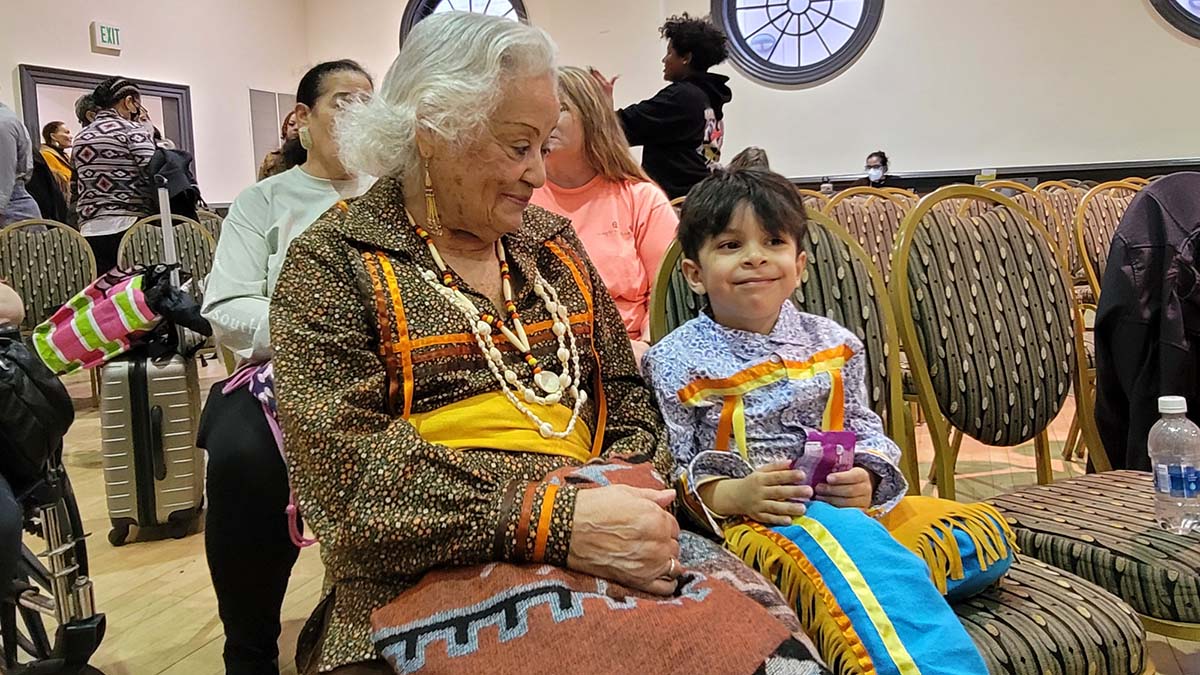
“We teach the young that we are all connected—both to each other and to our home,” Harley says.
ME: In the creation of these Native innovations, the dictum seems to be: provide for the common good while protecting the natural environment. How do you teach this to younger generations today?
Harley: We teach the young that we are all connected—both to each other and to our home. This is something we teach in our University Honors and College Park Scholars course, “Where the Waters Blend: Contemporary Indigenous Perspectives on History, Tradition, and Modern Issues.” We also teach this to young and old at our talks and exhibits at libraries, museums, and other community spaces. We need to work with, not against, the natural world.
ME: You are so active, sharing your people’s culture and history of observation and innovation with people around Maryland, the region, and beyond. Can you tell us about your latest projects?
Harley: This past spring, a tribal display containing one of our wampum belts and a 1777 treaty with the American government was installed at the Maryland Center for History and Culture in Baltimore. Made from the purple and white shells of the quahog clam, the recreated Piscataway wampum treaty belt is a physical representation of a historical agreement that we use to help teach the next generation of our significant historical events and commitments.
Last year, I worked with the Mount Vernon Ladies’ Association to provide an indigenous perspective to the Mount Vernon estate’s exhibits. We added to the story of diplomacy between the Indigenous peoples and George Washington, from his early days as a surveyor, then as a general, and then as president.
I also served as an Indigenous consultant for the movie “Young Washington,” which came out over the summer and presents the life of George Washington from childhood through the French and Indian War. As a consultant, I helped convince the producers to add authentic Indigenous languages to the movie, and we brought in the Seneca and Shawnee for that. It was great that we had the ability to influence the indigenous cast—including actors and stunt people—as well as the script, and even costuming, to add indigenous culture and humanity to the movie.
It’s nice to have these collaborations, including with the University of Maryland and the Clark School. This is our fourth fall teaching “Where the Waters Blend.” It’s popular, and so we may expand to a spring course in 2028. And thanks to our peace medal collaboration with the Clark School’s Terrapin Works makerspace labs, we have a display at the new Maryland Heritage Interpretive Center at Historic St. Mary’s City, which means hundreds of students and other visitors a day are able to learn more about Indigenous people and early Maryland colonial history.
Published November 2, 2026
Related Stories
Stories / November 3, 2025
Celebrating our Native and Indigenous Community

Stories / October 5, 2026
Celebrating LGBTQ+ History Month 2026

Stories / October 5, 2026
Mechanical Engineering Doctoral Student Rho Ma’s Varied...

Stories / October 1, 2026
Kelly M. is Learning (and Advocating for Students) by Doing

Stories / October 1, 2026
Aerospace Alum Pearl Uva ’26 Lifts Off—and Lifts Others

Stories / September 15, 2026
Honoring Achievement: Celebrating Latine Heritage Month

Stories / September 15, 2026
Tabatha Cuadra Rodriguez: Community Advocate

Stories / September 15, 2026
Jonathan Portillo Conducts Success as Fire Protection...

Stories / April 1, 2026
Celebrating APIDA and SWANA Heritage Month 2026
Stories / April 1, 2026
Miko Siarez Makes Good: Connection, Community, and Determination