News Story
Bio-Based Food Packaging Wrap Extends Shelf Life of Avocados, Cucumbers

A team of University of Maryland chemical engineers studying ways to leverage AI to improve post-harvest preservation have developed a new biodegradable food packaging material that protects produce from spoilage, significantly increasing its shelf life by two times.
Researchers in the Department of Chemical and Biomolecular Engineering led by Associate Professor Po-Yen Chen have developed an AI-powered design platform to create sustainable wrapping materials for food packaging. The research, which demonstrated the integrated use of robotic automation and AI predictions to enhance produce life, was published today in the journal Science Advances.
A challenge in the adoption of bio-based alternatives to plastic food packaging, failed and lengthy research and development processes, has enabled the reliance of the standard plastic wraps that are derived from petrochemical components—which exacerbate the environmental footprint of plastics and do not offer antimicrobial formulas to protect produce from spoilage.
To address this issue, Chen’s research team developed an integrated design workflow system consisting of automated robots, machine learning predictions and chemical engineering processes to develop a formulation that accomplished the team’s goal—creating a bio-based material with the mechanical strength of plastic wrap that extends the shelf life of avocados and cucumbers.
“Food packaging needs to do more than replace plastic, it also needs to protect the food inside,” said Chen. “By combining AI with robotic experimentation, we can accelerate the development of bio-based materials that help keep produce fresh and reduce food waste.”
Their experiments showed how Hass avocados wrapped in the bio-based packaging remained fresh for seven days when stored at room temperature, when compared to the spoiled, unpackaged avocados. Similarly, the team also demonstrated that cucumbers packaged into the standard Low-density polyethylene (LDPE) plastic wrap presented significantly more signs of spoilage by day 15 than those that were wrapped with the bio-based material.
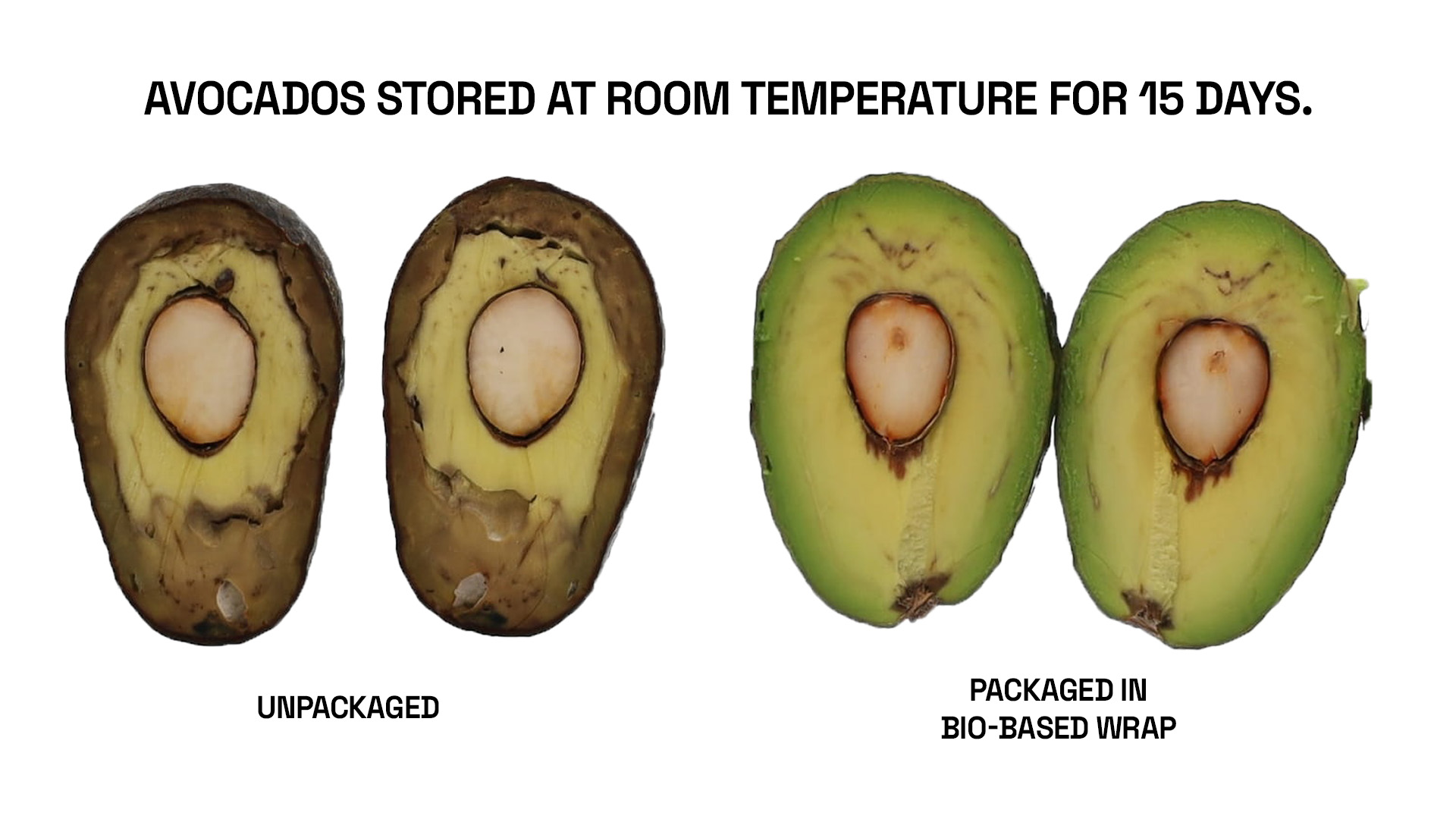
Currently, the newly developed eco-friendly packaging has antimicrobial properties that can protect produce such as avocados and cucumbers, but the team is working to extend the technology to other varieties such as fruits and vegetables. Additionally, the researchers released their AI design platform to the research community to allow for wide usage.
Media contact: Daniela Benites
Communications Coordinator
dbenites@umd.edu
Published October 28, 2026
Recent Stories
Stories / Oct 28, 2026
Bio-Based Food Packaging Wrap Extends Shelf Life of Avocados,...

Stories / Oct 28, 2026
ECE Alum Nicholas Sidiropoulos (M.S. ’90 / Ph.D. ’92)...

Stories / Oct 27, 2026
BIOE Senior Sulayman Khan Elected UMD SGA President

Stories / Oct 27, 2026
Professor Tom Marzetta Receives Test of Time Paper Award

Stories / Oct 26, 2026
Mickey Dale Symposium Advances the Future of Organ...

Stories / Oct 23, 2026
UMD to Lead Research on Shaping Intense Laser Light to Control...

Stories / Oct 23, 2026
Meet the Clark Scholars Class of ’30

Stories / Oct 21, 2026
ECE Alum Petru Andrei (Ph.D. ’04) Named Chair of FAMU-FSU ECE...

Stories / Oct 21, 2026
TEDx Talk Spotlights UMD’s Work to Improve Energy Efficiency...

Stories / Oct 21, 2026
Life After the Clark Scholars Program: Three Engineering...
