Redesigning Batteries for Ultrafast Charging EVs
Imagine charging your electric vehicle in the time it takes to finish your coffee. Chunsheng Wang is engineering a battery chemistry to speed charging times.

Imagine charging your electric vehicle in the time it takes to finish your coffee. Chunsheng Wang is engineering a battery chemistry to speed charging times.
It’s hard to ignore the difference: You can fill a car tank of gas in mere minutes. Charging the battery of an electric vehicle (EV) can take 30 minutes or more.
Chunsheng Wang, a Distinguished University Professor of chemical and biomolecular engineering, and his team are working to quicken that time—a critical step toward shifting from the dominance of fossil fuel-powered vehicles to cleaner, more efficient electric ones.
“If you want to compete with the gasoline engine, you have to have a similar charge time for the battery,” Wang says.
The U.S. Department of Energy (DOE) is calling for the development of EV batteries that charge to 80% in less than 15 minutes. Wang and Chang-Xin Zhao, a researcher in his lab, are working to exceed this goal by cutting charging time to as little as 10 minutes—what they refer to as “coffee time.”
“By the time you finish your coffee, the vehicle is charged,” Zhao says. “That’s what we want to achieve.”
| EVs Today* | DOE’s Target | Wang Group |
|---|---|---|
| 20–60 min | 15 min | 12.8 min |
* Using direct current fast charging. Level 2 chargers require 4–10 hours. Source: U.S. Department of Transportation Charger Types and Speeds
Previous efforts to expedite charging have focused on changing the structure of the battery’s electrodes, which inadvertently lowers the amount of energy a battery can hold—a problematic trade-off.
Wang’s group is devising ways to sidestep this trade-off by focusing on batteries’ chemistry. In research described in the journal Science, his team, which Zhao led, identified a limitation lurking in the electrolyte, the medium through which lithium ions travel when a battery is discharged or charged. During charging, the ions move from the battery’s positive terminal to its negative one. But they don’t make the journey alone: Each ion picks up several molecules from a critical component of the electrolyte, its solvent, and drags them along.
If charging proceeds slowly, the solvent flows back into the porous material of the positive terminal, refilling it. During fast charging, however, the solvent can’t keep up: The electrode dries out, and charging slows down markedly. Chemists already knew about this phenomenon—called electro-osmotic drag—in fuel cells, but its occurrence in lithium-ion batteries had been overlooked until this University of Maryland-led study.
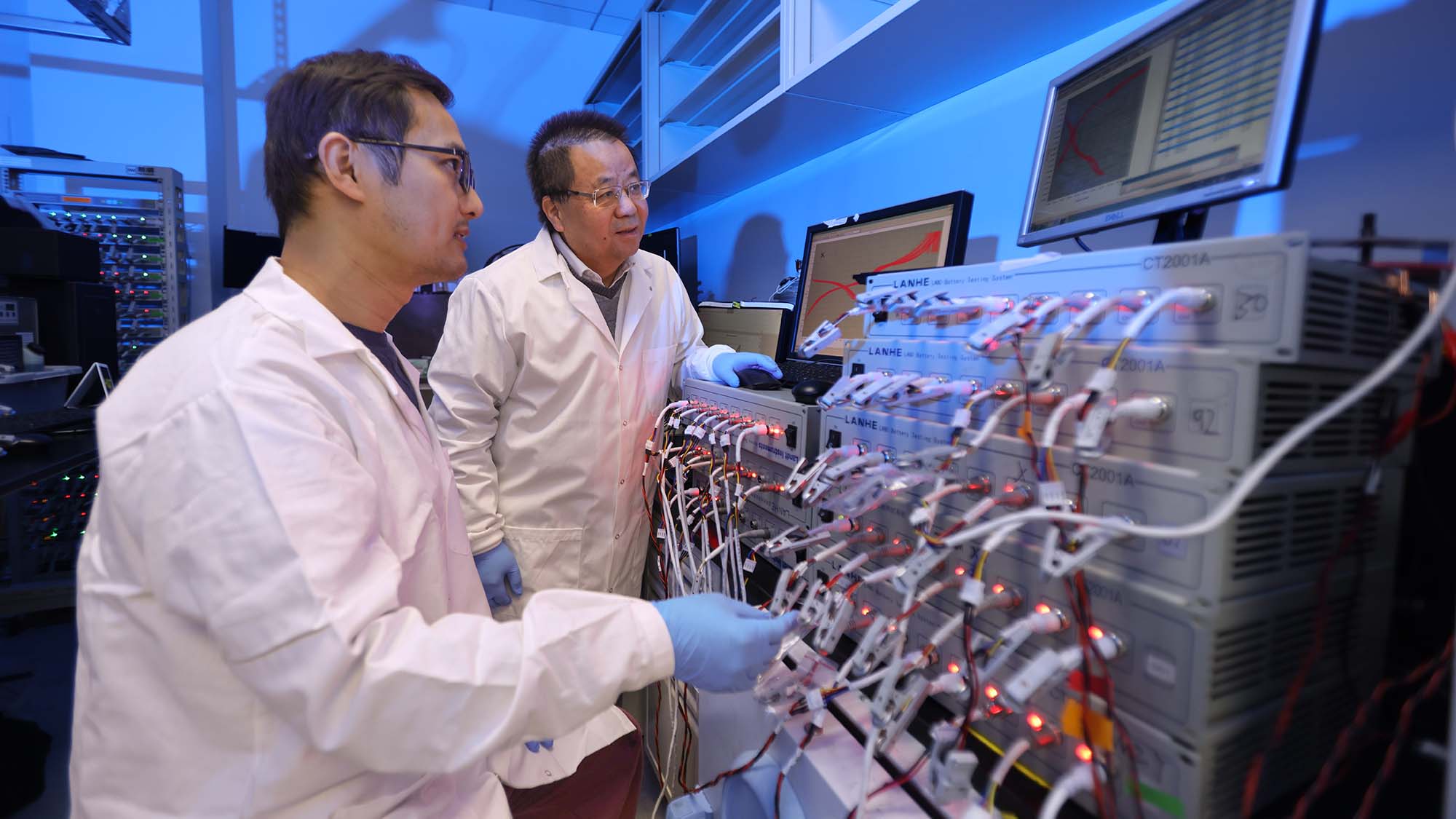 Wang (right) and his team perform innovative battery research in The Jeong H. Kim Engineering Building. (Photo by John T. Consoli)
The team found they could reduce the risk of drying out electrodes by redesigning electrolytes.
By adding fluorine-containing chemical groups to solvent molecules within electrolytes, the researchers reduced the attraction between the solvent and the lithium ions, and they encouraged the solvent to flow back into the positive terminal more readily. This new chemistry drastically reduces the chances of electrodes drying out, even at fast-charging speeds.
They tested the modified electrolyte by constructing a small battery called a four-amp-hour pouch cell. While it’s difficult to get to a 100% charge without sacrificing other aspects of battery performance, the results fell within the DOE’s targets:
 With continued research, Wang aims to reduce charging times even further, to 10 minutes. (Photo by John T. Consoli)
Wang aims to reduce charging times even further, to 10 minutes, by combining the fluorinated solvent with a second chemistry-based strategy: an adaptive electrolyte his team has developed. This substance separates itself to protect both terminals from the stresses of fast charging.
Shortening wait times is only part of the goal. His team is also working to extend how long batteries last when not being used, and the temperatures at which they operate.
“We want to build a battery that can satisfy all the requirements, without sacrificing anything,” Wang says. “That is our goal.”