Solving the Physics of Hypersonic Air Travel
Can a human travel 5x faster than the speed of sound? Christoph Brehm is working to overcome the challenges of designing ultrafast vehicles.

Can a human travel 5x faster than the speed of sound? Christoph Brehm is working to overcome the challenges of designing ultrafast vehicles.
Fly from New York to London, and you’ll need 14 hours for the round-trip flight.
But in the future, super-fast hypersonic travel could compress that trip into a fraction of the time—perhaps less than two hours each way—opening the possibility that same-day, round-trip transoceanic journeys could become routine.
The University of Maryland has worked at the forefront of this field of aerospace engineering for decades, and Associate Professor Christoph Brehm is among the faculty continuing this legacy. Brehm uses computational tools to study the distinct challenges of traveling at Mach 5, or five times the speed of sound. These hypersonic velocities exceed 3,830 miles per hour—far beyond that necessary to initiate a thunderlike sonic boom.
| Flight | Mach 5 | Time Saved* |
|---|---|---|
| NYC to London | 1.8 hrs | 5.4 hrs |
| LA to Tokyo | 2.5 hrs | 8.6 hrs |
| LA to Singapore | 3.6 hrs | 13.5 hrs |
* Compared with subsonic, Mach 0.85 flight.
Source: Commercial Hypersonic Transportation Market Study (PDF), Deloitte, April 2021
Brehm’s research focuses on addressing a physical phenomenon holding back this technology: turbulence. This chaotic airflow drives hypersonic flight’s enormous demand for fuel, and the potential catastrophic heat that it generates.
Because of complications from turbulence and other challenges, today’s hypersonic flight is limited to spacecraft when leaving and re-entering Earth’s atmosphere and unmanned defense systems. While the U.S. is pushing to advance use of this technology, hypersonic flight for the average traveler remains distant.
“Like many other technologies, hypersonics will trickle down to commercial use,” Brehm says. “It’s very futuristic—but that’s what we do research for.”
 Laminar flow is smooth and orderly around an object, but turbulent flow results in chaotic air movement, or drag, that slows the object. Turbulence leads to increased fuel consumption and heat.
As air flows over a moving object, like an airplane in flight, it starts out smooth and orderly—what engineers call laminar flow. That smooth laminar flow eventually breaks down into the chaos of turbulence.
At hypersonic velocities, this shift is especially problematic. Turbulent air flow generates much more drag, which increases fuel consumption. Perhaps even more importantly, it creates heat, which—if not properly managed—can destroy a vehicle.
“This whole business of laminar flow becoming turbulent flow is a big deal,” says Kevin Bowcutt ’82, M.S. ’84, Ph.D. ’86, the chief scientist of hypersonics at The Boeing Company, whose graduate research at Maryland led him to work on several high-profile hypersonics projects. “The question is: could we delay turbulent flow, or even prevent it entirely?”
One of Brehm’s projects aims to do just that: delay or stop the chaos of turbulent flow.
As part of a seven-institution team funded by the U.S. Office of Naval Research, Brehm is collaborating on the development of a material designed to maintain smooth laminar airflow for as long as possible. The design relies on a “piano key” structure that’s only a few millimeters thick: Individual segments of the material move independently to drain energy from pressure fluctuations, and to prevent the transition to turbulence.
Based on rough calculations from an experiment with a glide vehicle, the team estimates that sustaining smooth laminar flow could cut drag enough to increase capacity for cargo by roughly 25%. Such an improvement could slash fuel consumption, making the technology more economically and environmentally feasible—and, one day, more amenable to commercial air travel.
“That’s obviously a massive increase in payload,” Brehm says. “We’re just starting to realize hypersonic flight systems, and this could be a stepping stone in that direction.”
Even so, this calculation overlooks another crucial factor: heat. Reducing or even preventing turbulence-related heat would mean decreasing the size of the vehicles’ thermal protection systems, which can be quite heavy. The researchers have not yet calculated the benefit, but they anticipate that reducing these systems could result in an additional—and also substantial—increase in payload.
At Boeing, Bowcutt sees hypersonic technology doing more than shortening transoceanic flights. Reusable hypersonic vehicles built like airplanes—long-lived and quick to turn around between trips—could bring down the cost of reaching orbit enough to open space to tourism and new industries.
“We went from walking, to riding horses, to aircraft, then spacecraft. We’re always trying to get around efficiently,” Bowcutt says. “Someday, we’ll get to hypersonic flight.”
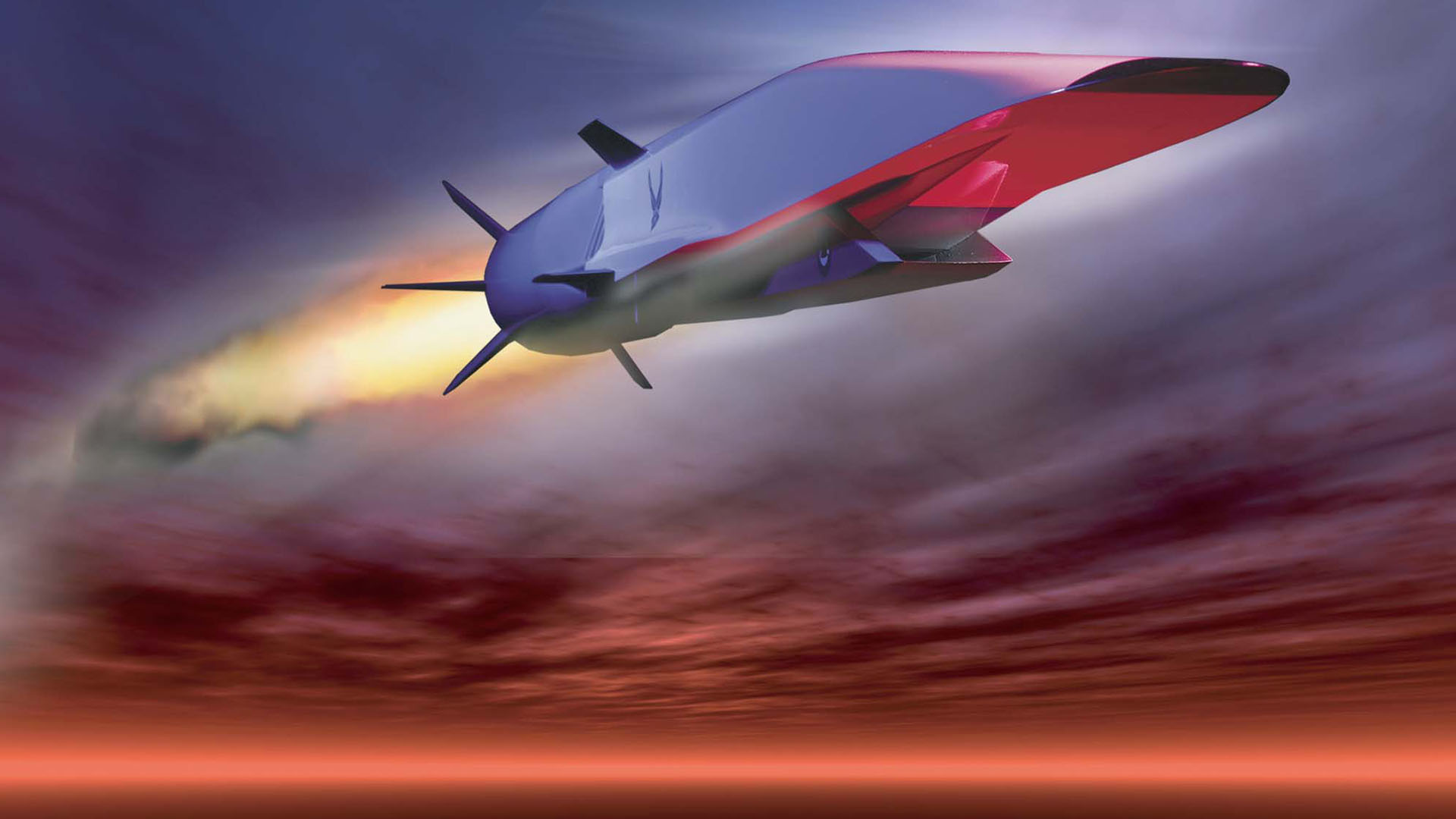 An artist’s rendering of the Boeing X-51 Waverider. Bowcutt leveraged the “wave-rider” hypersonic concept as a UMD doctoral student. (Rendering by the U.S. Air Force)