Building Safer with Performance-Based Design
At UMD, Rosalie Hrybyk ’13, M.S. ’15 teaches advanced computer modeling to keep pace with fire risks, and to keep people—and the buildings they occupy—safer.

At UMD, Rosalie Hrybyk ’13, M.S. ’15 teaches advanced computer modeling to keep pace with fire risks, and to keep people—and the buildings they occupy—safer.
Adopting new fire codes can take years, but fires burn on their own timelines.
The University of Maryland’s Department of Fire Protection Engineering—home to the only ABET-accredited undergraduate program of its kind—trains students to innovate before codes catch up to emerging fire risks, in part by using computer modeling to anticipate dangers and test solutions.
Rosalie Hrybyk ’13, M.S. ’15, an assistant clinical professor and professor of practice, draws on a decade of experience as a licensed fire protection engineer to advance computer modeling in the department’s undergraduate curriculum: Working in industry, she specialized in performance-based design, a modeling-driven approach for protecting buildings without relying on inflexible, slow-to-change regulations.
Performance-based modeling has, for example, made it possible for engineers to account for the new fire risks that electric vehicles and charging stations pose within parking structures, even as fire codes are still being updated.
“There’s always a drive for new, improved technologies,” she says. “But to keep people safe, fire protection engineers need to constantly stay ahead of advancements, and their potential hazards.”
UMD reports a 100% job and graduate school placement rate for grads of its undergraduate fire protection engineering program.
“We have more companies at our career fair than we have students, and those companies often have multiple openings,” says Rosalie Hrybyk ’13, M.S. ’15, an assistant clinical professor and professor of practice.
“If one values job security, there might be no better time than the present to become a fire protection engineer. For at least a decade, fire protection engineering firms around the world have struggled to find enough qualified people to help them tackle the growing number of projects that require fire and life safety design and oversight.” — Stoking the Flame, NFPA Journal
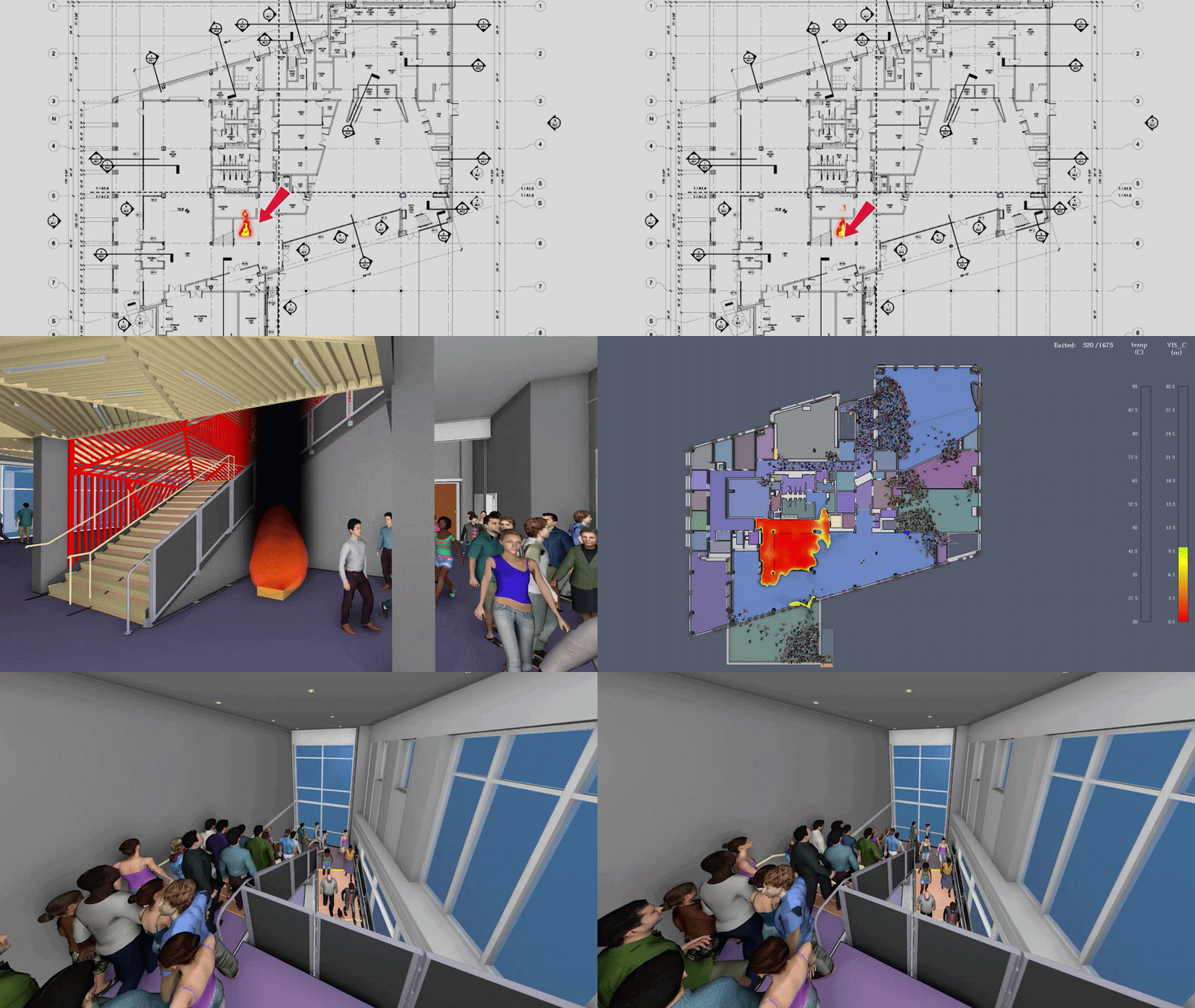 Hrybyk’s students used fire-simulation software to demonstrate their solutions for a building on campus.
Fire codes lay out prescriptive requirements meant to prevent fires and mitigate their damage.
Performance-based design, meanwhile, gives engineers controlled freedom to design: Engineers can explore how a fire might progress through a building by computationally modeling its behavior, as well as occupants’ ability to escape to safety.
The modeling can be used to verify whether protective measures—including those ahead of the code—will keep people safe.
This approach allows engineers to outpace fire codes. It can be especially useful for projects involving ambitious architecture; environmentally driven, timber-heavy construction; or energy storage systems that rely on potentially combustible lithium-ion batteries, according to Hrybyk.
Since her arrival, Hrybyk has incorporated more performance-based design into the fire protection engineering curriculum. With colleagues and partners in the industry, she has developed and implemented a fire protection engineering course centered on the commonly used lithium-ion battery, which can overheat and enter “thermal runaway,” a heat-release cascade that’s difficult to stop.
Another new class focuses on structures threatened by wildland fires, which are growing more costly and destructive.
 Hyrbyk is licensed as a professional engineer in California and Maryland.
Hrybyk made performance-based design the focus of the department’s senior Spring 2026 Capstone Design Expo projects.
As a fire protection engineering student of Hyrbyk’s, Adam Brodsky ’26 gravitated toward the computer modeling that’s central to performance-based design. For their senior capstone project, he and other students applied this approach to a real structure on the UMD campus, focusing on the building’s two open staircases—which create bright, airy spaces, as well as the opportunity for smoke to travel if a fire breaks out.
The building’s fire protection plan had already been approved by Prince George’s County. Working with the same building plan, Brodsky and his fellow graduating seniors asked: What if the design hadn’t been approved? Then, they modeled the building in fire-simulation software and designed new solutions—including glass baffles suspended from the ceiling to slow the spread of smoke—intended to protect occupants while preserving the building’s architectural beauty.
“Fire codes can be a cookie-cutter template,” Brodsky says. “I like having the freedom to come up with unique solutions for unique buildings.”
This fall, he began UMD’s fire protection engineering master’s program, where he plans to use machine learning and computational models to predict wildfire spread faster and more accurately. He envisions himself working in performance-based design eventually, or perhaps developing new fire protection systems.