News Story
Searching for ET—One Particle at a Time
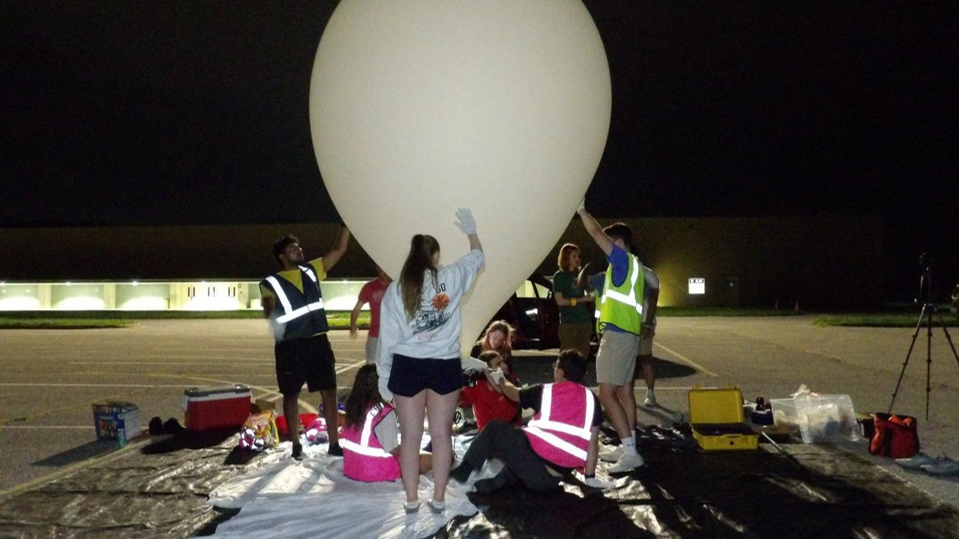
Balloon Payload Program students prepare for their first night flight. Photo credit: Kaelyn Serio, BPP Board Member & the team’s Outreach/Social Media Coordinator
Shortly after midnight on a warm summer night, a group of University of Maryland students gathered in a junior high school parking lot in Chambersburg, Pennsylvania. Equipped with cameras, lights, large helium tanks and enough gear to raise a few eyebrows, the group of students milling around in reflective safety vests set an odd scene for rural Pennsylvania.
Those students are part of the University of Maryland’s Nearspace Balloon Payload (BPP) Team, and they were preparing for their first ever night launch planned to coincide with the Perseid Meteor Shower.
The unusual mission stemmed from an aerospace engineering honors thesis by Akemi Takeuchi ’26, who developed CATITO (Cosmic Atmospheric Terrestrial Identification of Trapped Objects) to combine her engineering background with an emerging interest in planetary science.
“I was really excited to mesh my engineering and my science interests into my aerospace honors thesis,” said Takeuchi, who is now a Ph.D. student in Earth and Planetary Science at the University of Hawaii at Manoa. “And this night flight is what came of it.”
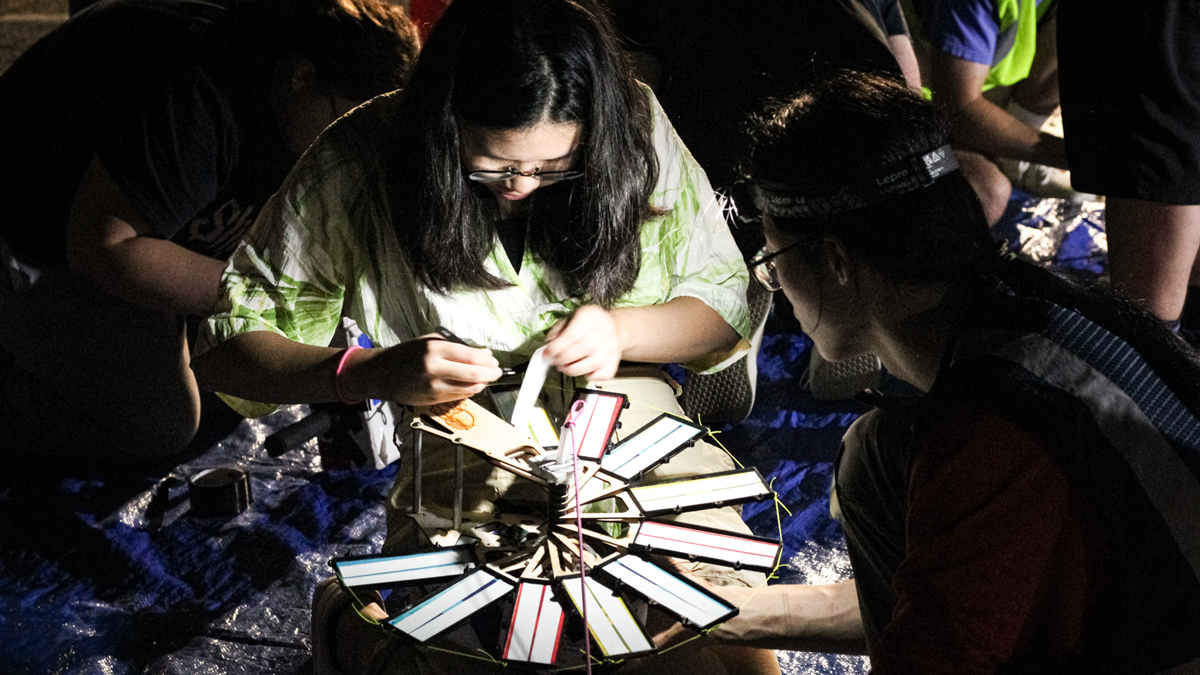
Takeuchi making final adjustments to CATITO as they prepare for launch. Photo credit: Sam Heintz
Looking for Something Not of This World
Takeuchi’s CATITO uses 11 deployable panels containing carbon tape, a tacky material typically used to hold samples for analysis under an electron microscope. Once aloft aboard the balloon, the panels open to collect whatever microscopic material happens to be passing through the atmosphere before closing again to protect the collected samples.
Previous flights had gathered particles, but Takeuchi had not identified material she believed to be extraterrestrial. Perseids offered another opportunity.
Each summer, Earth passes through debris left along the orbit of Comet Swift-Tuttle, and for Takeuchi, that debris stream created an increased possibility of intercepting particles high in the atmosphere.
“Basically, we were testing, is it possible to collect extraterrestrial material on a low-cost stratospheric balloon flight?” Takeuchi said. “And I would say that we’re fairly confident that we did collect extraterrestrial material.”
The appeal goes well beyond simply being able to say the team collected something from space. Extraterrestrial particles, or interplanetary dust particles (IDP), are rare and scientifically valuable because of what they may tell us.
“Analysis of these particles can provide valuable insight into the origin of not only the solar system, but also planetary bodies and how life started,” Takeuchi explained. There are also very few IDPs available to study as most of them burn up in Earth’s atmosphere, and if they survive, they are compromised by heat and terrestrial weathering.
After the flight, she took the samples to the Johns Hopkins University Applied Physics Laboratory, where she examined them with postdoctoral research associate Dr. Alexander Kling using scanning electron microscopy which allows for imaging and elemental analyses of the small particles.
Among the microscopic material, Takeuchi found two intriguing types of particles: one resembling a flattened droplet of metal and others that appeared unusually angular and heterogeneous. Elemental analysis found combinations including iron, nickel and sulfur that led Takeuchi to believe at least some of their collected particles may be extraterrestrial.
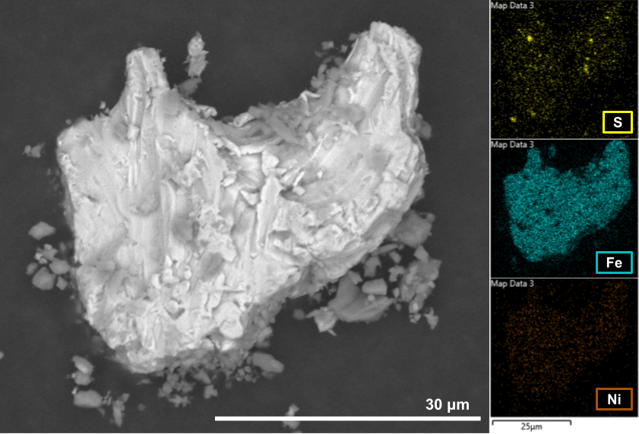
Backscattered-electron image and energy-dispersive X-ray spectroscopy elemental maps of one of the collected particles showing a relatively flat and homogeneous particle rich in iron, nickel and sulfur which suggest an extraterrestrial origin. Photo credit: Akemi Takeuchi
The results remain something Takeuchi approaches with scientific caution, but they were enough to surprise someone who started the project unsure if it would work at all.
“When I initially started this project, I was like, there’s no way I’m going to collect extraterrestrial particles,” she said. But after seeing “extremely strong candidates of extraterrestrial material” under the microscope, she said the experience felt “so much bigger than I could ever imagined it to be.”
In addition to potentially collecting IDPs, Takeuchi thinks CATITO may have even collected samples of Comet Swift-Tuttle itself, which means potentially sampling the solar system as far out as the Kuiper Belt.
Learning to Hover at 86,000 Feet
Collecting extraterrestrial particles was only part of the challenge. First, they had to reach, and stay, at the right altitude.
The longer CATITO could remain high in the stratosphere, the more time it had to gather particles in an environment with less potential terrestrial contamination. Instead of simply allowing the balloon to continue climbing until it burst, the team wanted it to hover at a predetermined height.
That task fell in part to rising junior, aerospace engineering student Wyatt Bland, and GHOUL, (Generalized Helium Outgassing Unit for Latex Balloons) the autonomous venting system he developed for this balloon mission.
Mounted in the neck of the balloon, GHOUL releases small amounts of helium to slow the balloon’s ascent. Earlier versions of the system required commands from the ground, which introduced delays as telemetry was received, interpreted and commands sent back.
Bland spent the summer developing code that allowed the system to measure its own ascent rate and determine when and how long to open the vent to maintain altitude.
“My goal was to automate the process using a microcontroller on board and to have it tune its own efficiency,” Bland explained. Although the system initially overshot its intended altitude, “the fact that it even achieved a float automatically is novel and that made it very successful.”
The balloon remained near 86,000 feet for 40 to 45 minutes, extending CATITO’s collection time. Takeuchi noted that it was also the first time the venting system had achieved autonomous neutral buoyancy and full-system operation after years of development on the BPP team.
That capability could eventually serve experiments well beyond CATITO. Aircraft have difficulty operating at such high altitudes, while experiments traveling higher quickly enter the far more expensive realm of rockets. A balloon that can reach a target altitude and remain there offers students and researchers another way to gather data from a difficult-to-access region of the atmosphere.
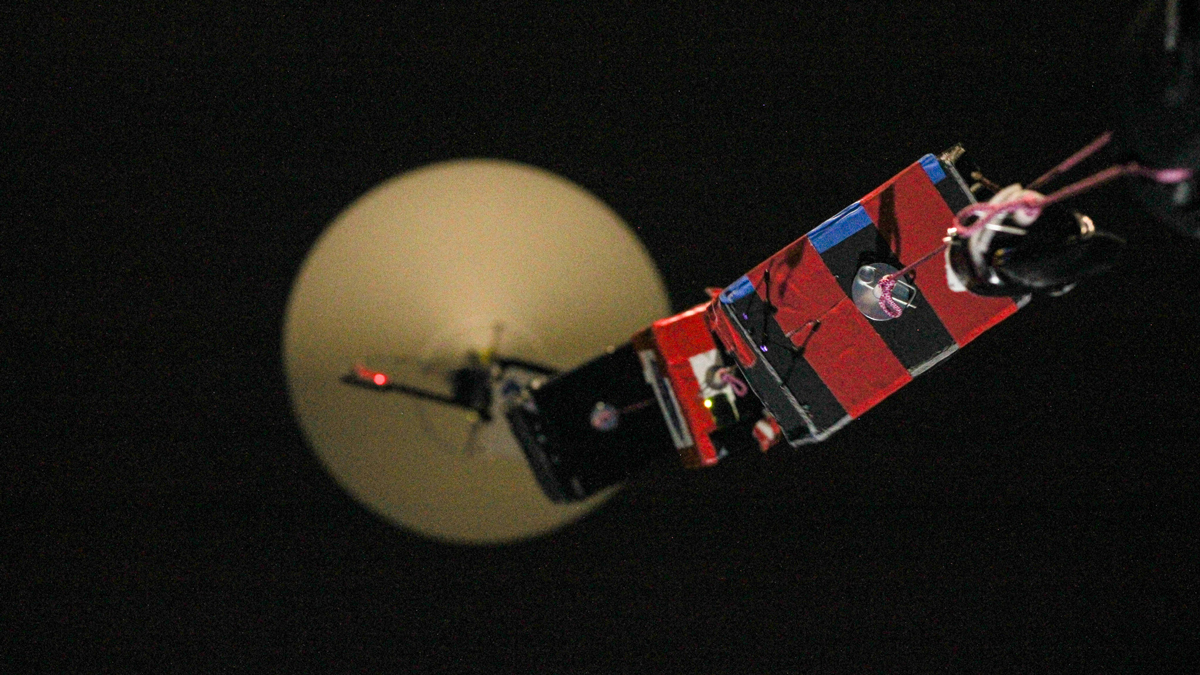
The payload ascends into the night sky. Photo credit: Sam Heintz
Lighting Up the Night
The decision to launch after dark created yet another engineering problem for the team’s mission: The balloon had to remain visible under Federal Aviation Administration requirements, and this is where mechanical engineering student Joe Manturuk came in. Even though he just joined BPP this summer through the Clark Scholars Program, he succeeded in developing four synchronized strobe-light payloads mounted along the flight line.
Below 60,000 feet, the lights needed to be visible from five miles away and flash between 40 and 60 times per minute. Manturuk engineered each strobe to carry its own battery, microcontroller and pressure sensor to estimate altitude, with one master unit coordinating the others.
The result was both functional and unexpectedly photogenic.
“There were four lights on the balloon flashing in sync,” Manturuk said. “I think it does make it more visible for them to be flashing in sync. And also, it looked pretty darn cool going up.”
For a team accustomed to daylight launches, the new conditions affected everything else as well. Students adjusted their sleep schedules, rotated drivers to ensure those behind the wheel were well rested and brought headlamps, floodlights and other equipment to illuminate their launch site.
Despite those complications—and a crew of about 15, far smaller than most daytime launches—team members said the launch itself went remarkably smooth.
Recovery was another matter.
The 4 A.M. Problem
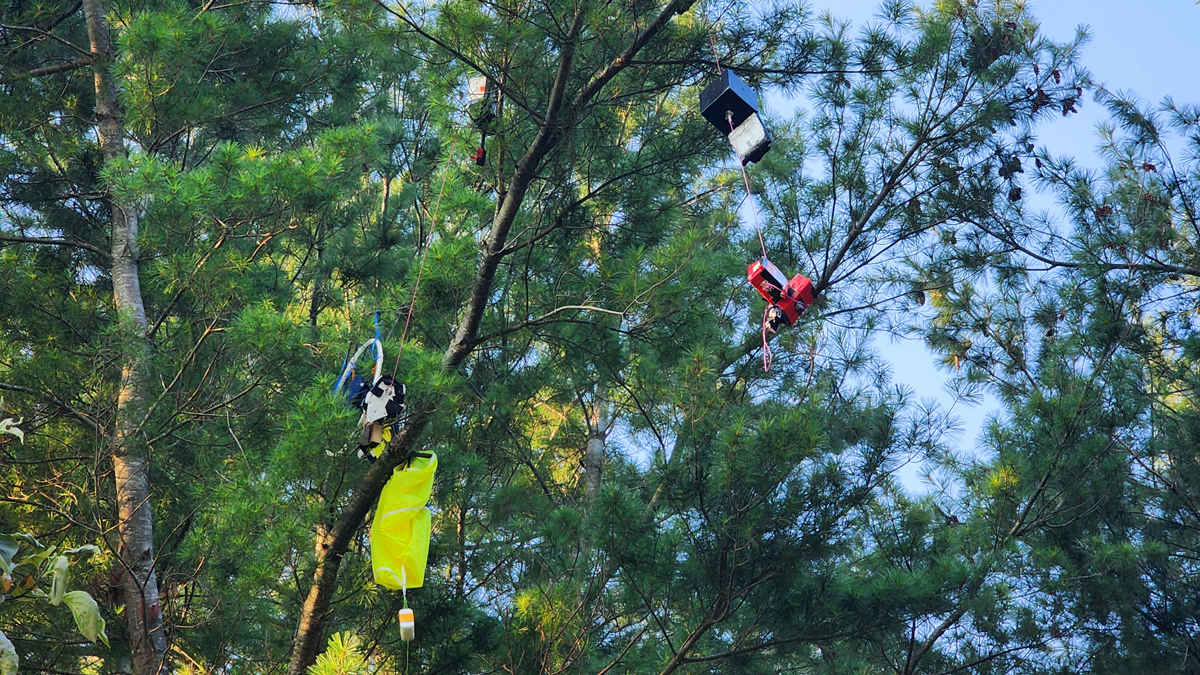
Photo credit: Jeremy Snyder
The balloon descended west of Westminster, Maryland, eventually coming to rest in a tree on private property in the early morning hours.
“We quickly realized our horrible mistake as all of us, like in a convoy, were driving into this little neighborhood,” explained Sam Heintz, aerospace engineering senior and mission recovery lead. “We were quickly like, back, back, back, get out. It’s four in the morning!”
With darkness making recovery difficult to assess—and knocking on a stranger’s door in the wee hours deemed a less-than-ideal decision—the team retreated and waited, returning at a more reasonable time to obtain the homeowner’s permission and coordinate with their tree climber.
The strobes, fittingly, were still flashing when the payload line was spotted in the tree.
Once recovered, the team confirmed that CATITO had done exactly what it was supposed to do: Its collection panels had opened in flight, gathered samples and closed again before landing.
For Takeuchi, the result provided an unexpected ending to her years of undergraduate research and her time on the BPP team, “This launch was so incredibly rewarding for me and a nice cap to my journey at Maryland.”
Looking ahead, the team believes their experiment may also offer a path for others to follow, along with future BPP missions. Takeuchi estimates a CATITO-like payload could be built for less than $500, putting similar experiments within reach of other university balloon teams. Her hope is eventually to document the design well enough that other students can build and fly their own versions.
For one night in August, though, the goal was simpler: send a balloon into the Perseids, keep it floating long enough to collect something interesting and bring it home. Mission accomplished!
CATITO was funded through the Maryland Space Grant Consortium and a UMD Honors Research Grant.
Follow the team on Instagram @umdnearspace.
Published September 28, 2026
Related Stories
Stories / October 1, 2026
Aerospace Alum Pearl Uva ’26 Lifts Off—and Lifts Others

Stories / August 19, 2026
Smooth Sailing: MATRIX Dives Into Ship Inspecting

Stories / June 25, 2026
Aircraft May Refuel Themselves - With Help From AI

Stories / May 13, 2026
Capstone Design Expo 2026: Students Solve for Maryland & Beyond
Stories / May 5, 2026
UMD Students Earn Top Honors at AIAA Regional Conference

Stories / May 6, 2018
Elon Musk Tweets Back
Stories / September 1, 2009
Barua Wins NSF Grant

Stories / October 5, 2026
Mechanical Engineering Doctoral Student Rho Ma’s Varied...

Stories / September 21, 2026
Ribbon-cutting Celebrates Baltimore Center Where Engineers,...

Stories / September 14, 2026
Project, Problem, Solution: MATRIX Interns Make an Impact