News Story
Aircraft May Refuel Themselves - With Help From AI

First author Ryan Lowe shows deep neural network technology to research group
A University of Maryland (UMD) graduate student working in the UMD A. James Clark School of Engineering MATRIX Lab is the first author on a research paper now published in the Journal of Aerospace Information Systems.
“Evaluating Single-Camera Range Estimation for Autonomous Air-to-Air Refueling” was written by Ryan Lowe (M.Eng. ’26, Robotics), Dr. Violet Mwaffo (United States Naval Academy), and Dr. Donald “Bucket” Costello (UMD Aero and MATRIX Lab). It outlines how AI can be used to help U.S. Navy aircraft autonomously refuel themselves mid-flight.
As the Navy expands its use of uncrewed aerial systems (UAS), those aircraft will need the same operational flexibility as manned platforms, including the ability to remain airborne for extended periods and operate far from traditional support infrastructure. Autonomous aerial refueling can help with this, however, the systems need to be able to operate even when GPS and radio frequency communications are unavailable or unreliable. One solution is using onboard sensors and AI rather than relying on those external navigation aids. To test this option, Lowe and his team are analyzing whether a single lens camera combined with a deep neural network could accurately estimate the distance between aircraft components during autonomous air-to-air refueling.
“I am proud of the contributions Dr. Costello, the MATRIX Lab team, and I made towards advancing autonomous aerial refueling through neural network-based vision and control,” Lowe said. “I am excited about the future of autonomous UAS technologies and look forward to teaming with these systems during my service in the Navy.”
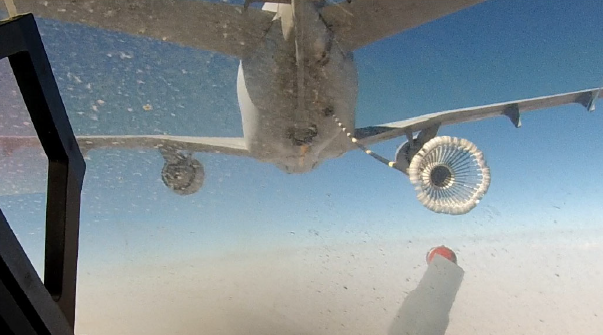 The team’s paper outlines their experiments, which were conducted in the MATRIX Lab’s Omni-domain Autonomous Systems Integration Space (OASIS). Researchers used the OASIS’ Vicon Vantage camera system to precisely measure the distance between aircraft components, then compared those measurements with distances estimated by a YOLO11m neural network AI system using camera imagery. The system demonstrated near-zero average error at close distances (5-17 feet) and errors under ten inches at further distances (up to 45 feet).
The results suggest that a lightweight, single-camera vision system could support autonomous aerial refueling, providing a practical path toward enabling future Navy uncrewed aircraft to refuel autonomously in flight.
“This work represents the first journal publication that was based on research conducted in the MATRIX Lab by our graduate students,” Dr. Costello said. “I am extremely proud of Ryan and the team.”
Lowe graduated with a master’s degree in robotics from the University of Maryland in May 2026. He finished his time with the MATRIX Lab in June 2026 and is now heading to flight school to train as a Naval Aviator.
Published June 25, 2026
Related Stories
Stories / August 19, 2026
Smooth Sailing: MATRIX Dives Into Ship Inspecting

Stories / January 13, 2026
Sensor Advancement Breaks Barriers in Brain-Behavior Research

Stories / July 23, 2026
New Graduate Program Teaches Real-World Autonomy Skills

Stories / May 28, 2026
Generations of Graduates: A Full-Circle Celebration
Stories / January 30, 2026
BIOE Researchers Publish Study Advancing Probiotic Vesicle...
Stories / January 16, 2026
Cholesterol Found to Play Key Role in Protecting the...

Stories / December 16, 2025
University of Maryland Represented at International Forum
Stories / November 18, 2025
BIOE Associate Professor Explores How Huntington’s Protein...
Stories / October 22, 2025
Erika Moore Named to Science News 2025 “Scientists to...
Stories / October 21, 2025
AI Tool Reveals Gaps in Ancestry Reporting Across Biomedical...