News Story
BIOE M.D.-Ph.D. Student Receives PhRMA Foundation Fellowship to Advance Gene Therapy for Parkinson’s Disease

Kijung Kwak, a M.D.-Ph.D. student in the Fischell Department of Bioengineering (BIOE) at the University of Maryland, has received a 2026 Predoctoral Fellowship in Drug Delivery from the PhRMA Foundation to develop a safer, more precise way to deliver gene therapy to the brain for Parkinson’s disease. The fellowship provides $30,000 a year in stipend support for up to two years.
Kwak’s funded project, “Novel Bioreducible Gene Delivery Platform to Treat Parkinson’s Disease,” combines tiny drug-carrying particles with focused ultrasound to move a therapeutic gene from the bloodstream into the brain, which is difficult because of the brain’s natural defenses. He conducts his research in Baltimore in the lab of Professor Jung Soo Suk in the Department of Neurosurgery at the University of Maryland School of Medicine (UMSOM). The lab develops technologies that deliver drugs to organs that are hard to reach, including the brain and the lungs.
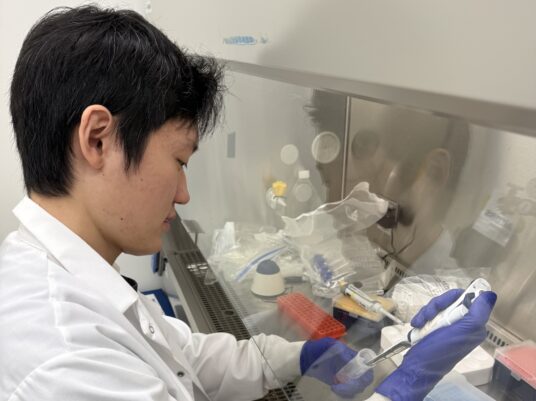
Parkinson’s disease has many causes, but changes in the GBA1 gene are a key genetic risk factor. GBA1 instructs cells to make an enzyme that breaks down certain fats in the brain. When the gene is faulty, those fats build up and disrupt normal cell function, making Parkinson’s more likely. Current therapies only relieve symptoms, while gene therapy aims to fix the underlying problem by delivering a working copy of GBA1. Researchers have tested GBA1 gene therapies that use engineered viruses as carriers, but the approach has limits. The blood-brain barrier (BBB), a protective layer of cells that controls what passes from the blood into the brain, blocks most viruses, so treatment generally requires injections directly into the brain. When viruses are delivered through the bloodstream instead, many end up in the liver, raising the risk of side effects, and the immune system builds antibodies against them, so a second dose is cleared quickly, limiting its effect.
Kwak’s project replaces the viruses with synthetic nanoparticles designed to carry GBA1 plasmids and release them inside cells. To get them into the brain, his team uses focused ultrasound, a beam of sound waves aimed at a specific brain region that safely and temporarily opens the blood-brain barrier for several hours.
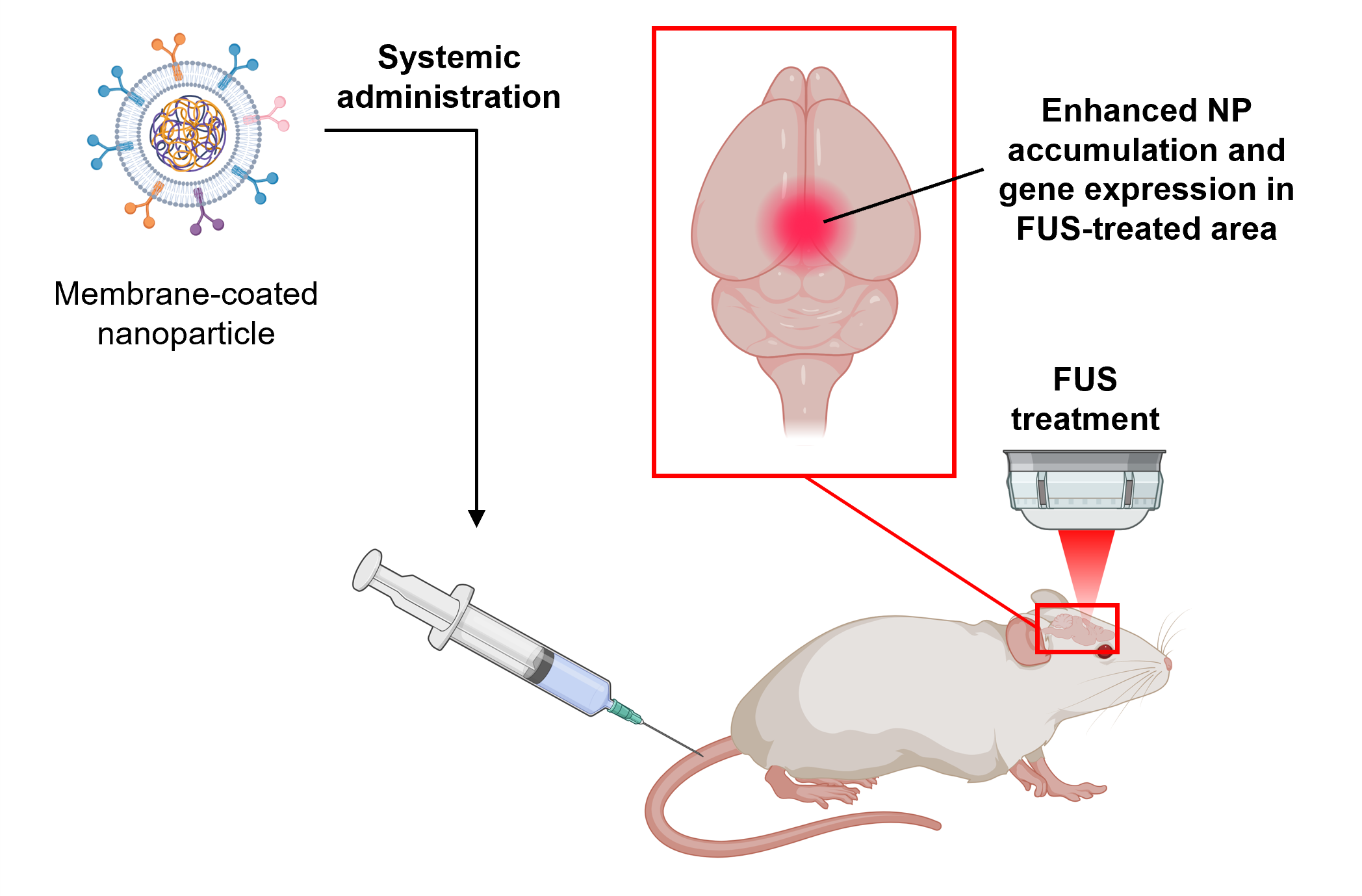
Even when open, the barrier admits only particles smaller than 100 nanometers, about one-thousandth the width of a human hair, according to earlier work from the lab. The team keeps its particles under that size and coats them with PEG, a protective polymer that keeps blood proteins from sticking to them. Without a coating, nanoparticles tend to clump in the blood and end up in the liver.
"Parkinson’s is such a complex disease. There are so many factors that play a role. More than curing Parkinson’s, the goal is to safely deliver therapeutics to the brain"
-Kijung Kwak
“It’s like an anti-fouling coating, similar to what you apply to boats so that barnacles don’t stick,” Kwak said. In early tests, the coated particles circulated longer than uncoated ones, reached the brain after focused ultrasound and delivered DNA that was detectable there 48 hours later.
The coating creates a trade-off. It helps particles circulate, but it also makes it harder for brain cells to absorb them. Kwak’s fellowship project tackles this by coating the particles with membranes taken from immune cells and stem cells. These membranes help the particles travel to specific areas of the brain and to inflamed tissue, which is common in Parkinson’s. The goal is a coating that lets particles travel stably through the blood and still enter brain cells.
Kwak is testing the approach in a mouse model of Parkinson’s disease, aiming to slow the disease’s progression. “Parkinson’s is such a complex disease. There are so many factors that play a role,” he said. “More than curing Parkinson’s, the goal is to safely deliver therapeutics to the brain.” If the strategy works, he said, it could be tested in larger animals and adapted to deliver other treatments, such as biologics or small molecules. His lab also works on other genetic disorders and Alzheimer’s disease.
Kwak said the fellowship validates his work and adds a source of funding. “It’s a validation that what I’m doing is meaningful and that, hopefully, down the line this can be applied to help patients,” he said.
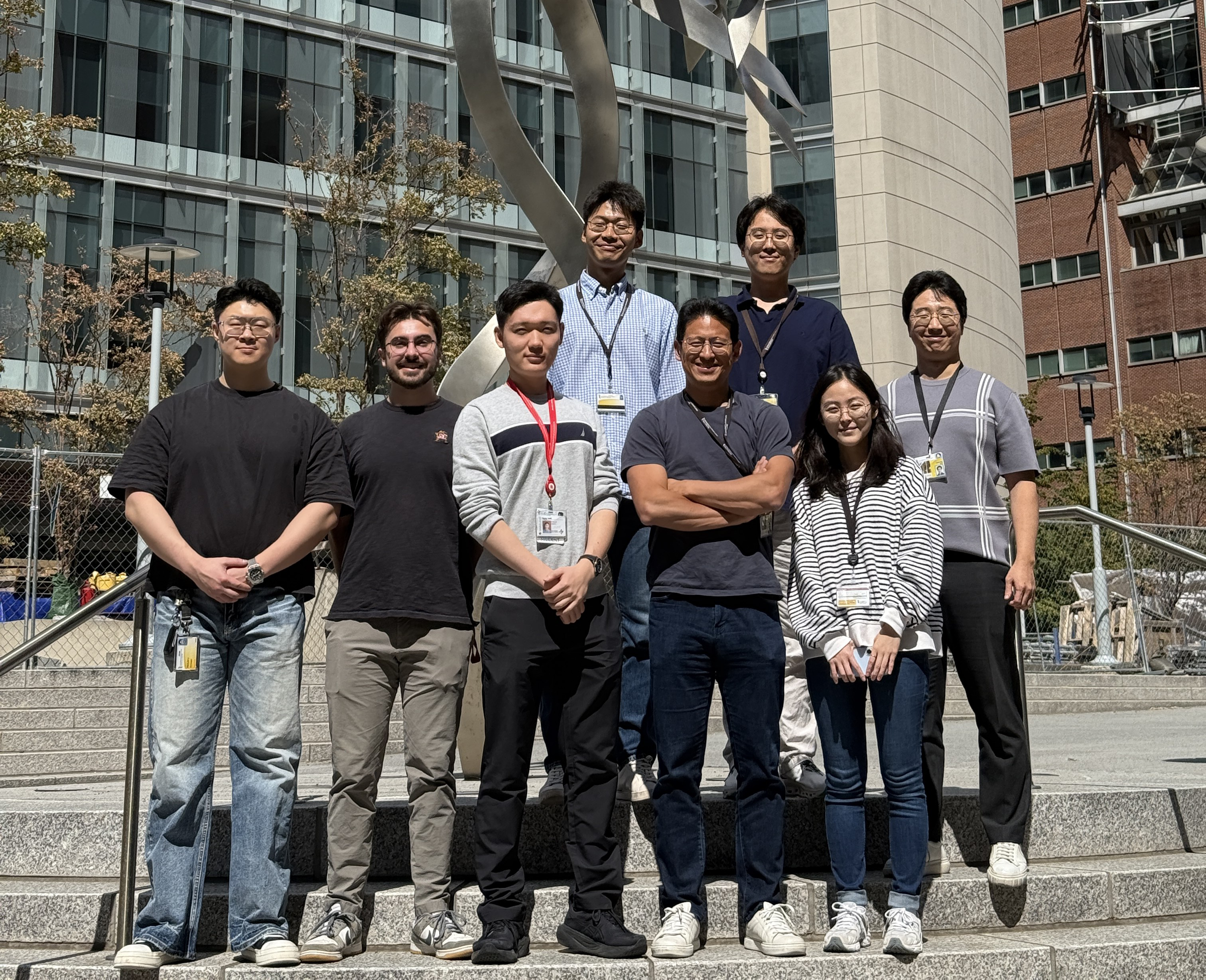
Kwak’s work builds on earlier research by Haolin Li, a fourth-year Ph.D. student from Johns Hopkins University who developed PEG-coated gene delivery nanoparticles that target the brain with focused ultrasound. Other lab members include BIOE Ph.D. student Owen Tabah, who is co-mentored by BIOE’s Associate Professor Gregg Duncan; M.D.-Ph.D. student Danya Adams, who is co-mentored by Assistant Professor Whitney Parker in the UMSOM Department of Neurosurgery; research associate Gijung Kwak, and postdoctoral fellows Daiheon Lee and Byoungjae Kong. Kwak said Suk has been an inspiring mentor who pushes him to think critically.
Kwak’s interest in medicine began with a hospital job in high school, where he saw how illness affects patients and families. After completing his Ph.D., he plans to return to medical school, complete a research-focused residency, and work as a physician-scientist who splits time between treating patients and running a lab.
Published November 9, 2026
Related Stories
Stories / October 27, 2026
BIOE Senior Sulayman Khan Elected UMD SGA President

Stories / September 29, 2026
BIOE Celebrates Five Award Recipients at Ninth Annual 2026 EPIC...
Stories / September 15, 2026
Jonathan Portillo Conducts Success as Fire Protection...

Stories / August 10, 2026
Gut Monitoring "Smart Pill" Testing Advances

Stories / August 4, 2026
Kuo Lab Hosts Future Bioengineers
Stories / July 13, 2026
Meet the Newest Cohort of the MARC Program

Stories / June 5, 2026
UMD Senior Joshua Mathew Wins 2026 Astronaut Scholarship

Stories / June 2, 2026
Wielgosz Receives ARCS MWC Foundation Scholarship

Stories / May 29, 2026
BIOE Announces Spring 2026 Instructional Impact Awards
Stories / May 28, 2026
Student Spotlight: Outstanding Junior Award Recipient Joel...