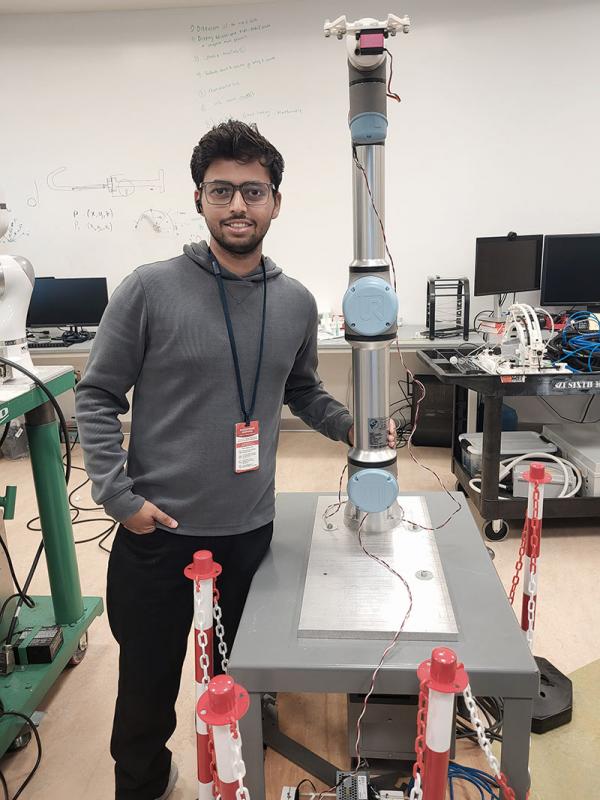
I worked with a UR5 robot, designed and tested a custom gripper, designed 3D-printed parts and laser-cut parts, designed electrical systems, programmed robot actions, built simulations, and spent a lot of time testing and debugging the full system.
Name: Rishi Rajesh Mehta
Major: Robotics
Employer: Children's National Hospital
Location: Washington, DC
How did you find the internship/co-op? What was the interview process like? I found this opportunity through Professor Reza Monfaredi, PhD, whose robotics courses I had taken at UMD in Fall 2025 and Spring 2026. Through him, I learned about the research at Children’s National Hospital and the opportunity to work with his team. The selection process involved discussing my robotics background, technical skills, previous projects, and my interest in gaining hands-on experience with real robotic systems.
What have been the most interesting aspects of your internship? The most interesting part was working on a robotic tool sorting and analysis system for the Sterile Processing Department. I worked with a UR5 robot, designed and tested a custom gripper, designed 3D-printed parts and laser-cut parts, designed electrical systems, programmed robot actions, built simulations, and spent a lot of time testing and debugging the full system.
What campus activities or courses do you think helped you, or would have helped you, with this internship? Courses such as ENPM662 Robot Modeling, ENPM667 Control of Robotic Systems, ENPM661 Planning for Autonomous Robots, and ENPM701 Autonomous Robotics were especially helpful. They gave me a strong foundation in kinematics, control, planning, and autonomous systems that I was able to apply directly to the UR5 project.
How would you describe the company culture? What was the most helpful thing your supervisor did to make you feel comfortable at the organization? The research environment at the Sheikh Zayed Institute for Pediatric Surgical Innovation was supportive, collaborative, flexible, and independent. My supervisor gave me the freedom to explore solutions on my own while still providing guidance through regular meetings, and I also had the chance to meet UMD alumni and senior students working in the same research environment.
Was there diversity among your colleagues within the department and throughout your internship/co-op experience? Yes. I worked around people from many different backgrounds, including engineers, researchers, doctors, surgeons, and students. Seeing people with different technical and clinical perspectives collaborate on healthcare projects was one of the most valuable parts of the experience.
Did the internship provide a solid education in professional ethics? If so, how? Yes. Working in healthcare robotics made me think more carefully about safety, reliability, testing, and the impact engineering decisions can have in real-world environments. I learned that it is not enough for a system to work once; it needs to be tested carefully, its limitations understood, and its use considered in the context of the people and workflows around it.
Was there a formal program for all interns at the company? Was peer support available throughout the internship? Within my team, we also had two regular meetings each week to discuss progress, challenges, and future work. Also, there were Lunch and Learn sessions, picnics, social events, FIFA and movie nights, project demos, lab tours, and monthly wrap-up meetings.
How have your career or academic goals changed as a result of this internship experience? This internship helped me find the direction I want to pursue within robotics. I realized that I especially enjoy working on real robotic systems where mechanical design, electronics, perception, programming, planning, and control come together, which strengthened my interest in robotic manipulation, robot learning, and embodied AI.
What advice would you give other UMD engineering students seeking an internship or co-op position? Start reaching out early and build connections with professors, researchers, alumni, and other students. I found this internship through a professor, and it showed me that networking and hands-on projects can open opportunities that may not always be posted formally. Also, do not wait until you know everything before applying, being willing to learn and troubleshoot is just as important.
Top