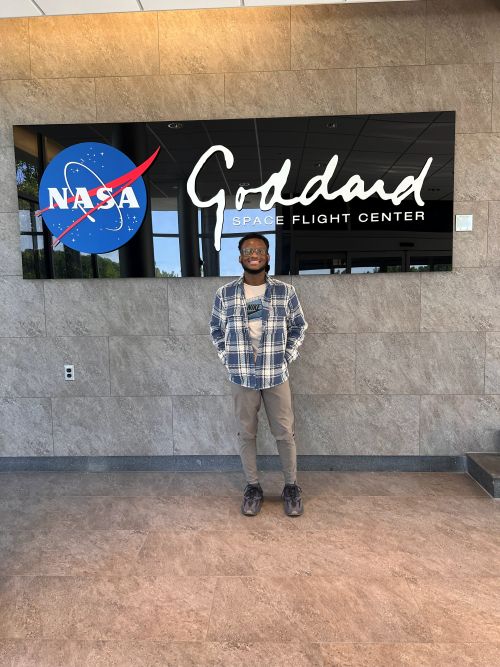
Ask questions, seek guidance, and do not be afraid to put yourself out there. You never know who may recognize your potential or connect you with an opportunity that can change your path.
Name: Joshua Budram
Major: Aerospace Engineering
Minor: Technology Entrepreneurship and Corporate Innovation
What Community College did you transfer to the University of Maryland from?
Prince George’s Community College
Why did you decide to attend UMD and the A. James Clark School of Engineering?
I decided to attend UMD and the A. James Clark School of Engineering because of the opportunities available to students and the quality of education at an affordable price. I was especially drawn to the strong engineering community and the opportunities to gain hands-on experience beyond the classroom.
What company did you work for?
NASA Goddard Space Flight Center
Where was your internship located? (City, State)
Greenbelt, MD
Give a brief description of your main roles and responsibilities during your internship.
During my internship, I analyzed data from NASA’s CDAW CME Catalog to investigate the relationship between coronal mass ejections (CMEs), Type II radio bursts, and Type III solar radio bursts. My responsibilities included examining CME speeds and radio burst timing, categorizing Type III events based on their relationship to Type II bursts, and using Python to implement the Newkirk electron density model to relate observed radio frequencies to CME heights. I also organized and analyzed the data, created visualizations to identify trends, and interpreted the results to investigate whether Type III bursts are primarily flare driven or can also be associated with CME driven shocks.
How did you find the internship/co-op? What was the interview process like? What advice do you have for students in their search process?
I found this internship opportunity through my Physics professor at Prince George’s Community College (PGCC), Dr. Neeharika Thakur, who was the Principal Investigator for the NASA MUREP Curriculum Awards (MCA) grant. Dr. Thakur encouraged me to apply for NASA internship opportunities and supported me throughout the process by helping me strengthen my resume and application materials. Thankfully, I did not have a formal interview process for this opportunity. Her recommendation played a major role in my selection, and I am grateful that she recognized my potential and believed in me. My advice to students searching for internships is to be kind, build genuine relationships, and take the time to get to know your professors beyond the classroom. Ask questions, seek guidance, and do not be afraid to put yourself out there. You never know who may recognize your potential or connect you with an opportunity that can change your path. My experience with Dr. Thakur showed me that sometimes, one person believing in you can help turn an opportunity that once seemed impossible or out of reach into reality.
How was your engineering education relevant to your internship?
My engineering education provided the foundation I needed to approach this research. My coursework in physics, mathematics, and programming helped me understand the science behind CMEs and solar radio bursts, analyze large datasets, and use Python to model and visualize the results. The internship allowed me to apply these skills to a real aerospace research problem while strengthening my ability to approach complex problems analytically.
What were your non-technical takeaways from the internship?
One of my biggest non-technical takeaways was the importance of reaching out and learning from the people around you. I learned to introduce myself, ask questions, and seek out people who are doing work that interests me. I also realized that mentors can help connect you with professionals who can provide valuable insight into different career paths. During my internship, I had the opportunity to speak with an Aerospace Structural Engineer at NASA Glenn Research Center and learn about her journey. Hearing how she reached where she is today gave me a better understanding of the different paths available to me and the importance of building relationships along the way.
How has the internship experience changed or contributed to your academic or career goals?
This internship gave me a clearer understanding of how aerospace engineering can be applied to space science and research. It strengthened my interest in pursuing graduate school and a career that combines aerospace engineering with space research. It also gave me greater confidence in my technical and research abilities and showed me the value of gaining experience beyond the classroom.
Top