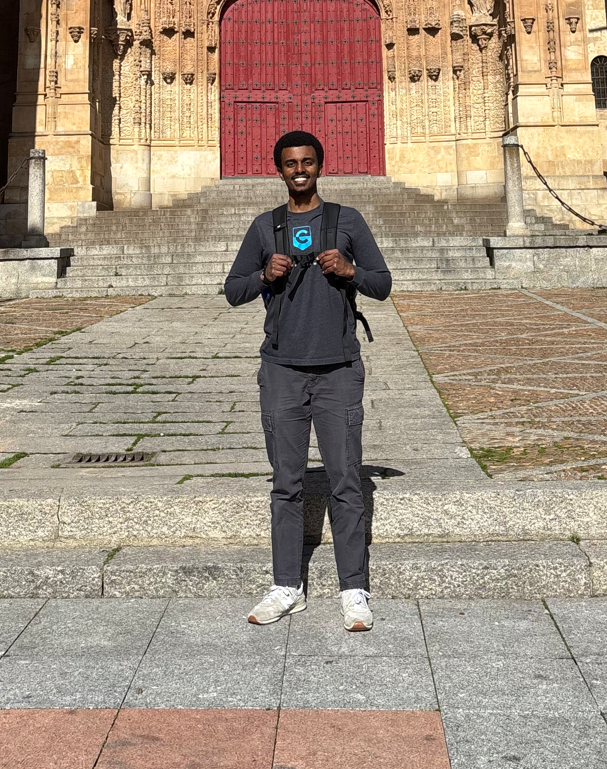
The unplanned activities are often more exhilarating and somehow end up being worthwhile.
Name: Abel Eshetu (Cohort 6)
Major: Mechanical Engineering
Minor: Global Engineering Leadership
Give a brief description of the experience.
I’ve been learning Spanish for quite some time, and to have come this far without stepping foot in a country where it is the native language felt like a shortcoming. It’s one thing to learn a language from afar and another to truly experience it by interacting with citizens and becoming part of the culture in every possible way. This is why I took it upon myself to study abroad in Madrid at the Universidad Pontificia de Comillas. While abroad, I visited a plethora of cities within Spain that had different dialects and specialty dishes, from the northern region of Bilbao to the eastern side of Valencia. I also had the opportunity to travel to the “Big 5,” with Spain as my primary destination, as well as Portugal, Morocco, Greece, and Italy. Each country offered experiences I can’t put into words, so much so that half my camera roll is pictures from abroad.
What was the most impactful part of the experience?
It was through this experience that I gained a deeper understanding of myself. When you have no safety nets around you, it truly is up to you how you choose to spend your time abroad. The most impactful part was discovering my passion for hiking. What brings peace and solitude to the soul brings pain and agony to the body, a concept that reminds me of my faith, which is why it touched me so dearly. Not to mention that some of the hikes I went on had a standing cross at the highest elevation point. My passion grew so much that I hiked up an active volcano in Sicily, where I reached an elevation of 2,900 meters, in other words, above the clouds. In addition to these nature-esque adventures, I enjoyed my time feeding the pigeons and fish at Madrid’s largest park. These experiences gave me a deeper appreciation for nature.
What surprised you?
I was surprised by how time is perceived in Spain, almost as if it moves two times slower than it does in the U.S. With the competitive and productive nature of the U.S., Spain, on the other hand, is completely different. I would describe Spain’s dominant culture as one of enjoying life in every moment. The concept of a siesta (midday rest) is deeply ingrained in Spain, and it all connects to the importance of work-life balance and keeping stress at a minimum. So, having to adjust to the antithesis of American work culture is what surprised me.
Did you make any personal and/or professional connections with peers?
I made a genuine connection with my Venezuelan barber, with whom I had the chance to flex my Spanish speaking skills. Though intimidating at first, he made the conversation flow in a way that made me feel comfortable responding. It wasn’t the smoothest conversation, but it was good enough that my message was understood. Given how difficult it was to find someone who could cut my hair texture during my last week, I took the time to go back and have one final conversation on my way out.
What were your major takeaways? What did you learn?
My biggest takeaway was to prioritize being in the moment and taking the time to understand the cultural norms. The idea of traveling to as many places sounds fun, but to travel there and immerse yourself in the city like a true local would makes for a better experience than claiming you stepped foot in however many places. The tourist mindset puts you in a place where you are constantly thinking about the next thing to do, as if it’s a checklist. A prime example is a tourist who takes a picture in front of a building, statue, or some sort of landmark. As soon as the picture has been taken, they are off to the very next thing on their checklist, where no time has been taken to understand the how or even why. Not only are you constantly rushing to fit as much as you can on an itinerary, but it also lacks depth. This was a big mindset shift for me early in my study abroad experience, where I took the time to do things that I found to be valuable, allowing me to enjoy being present and informing myself about the culture instead of doing whatever every other person has done.
How have your career or academic goals changed or evolved as a result of this experience?
Witnessing the importance of collaboration in materials lab has shown me how valuable it is and something I seek in my future career. It’s one thing to collaborate with partners in a group and another to collaborate with other lab groups. What I enjoyed was that the labs were structured in a way where you had to rely on other groups for important data. It forced us to work cohesively together and practice cross-functional collaboration.
What is one piece of advice you would give to another Clark Scholar about engaging in this experience and/or pursuing an experience like this?
As someone who is not spontaneous and likes everything planned out ahead of time in a structured manner, I urge you not to worry. The unplanned activities are often more exhilarating and somehow end up being worthwhile. They put you in situations where you need to be quick on your feet, but through all that chaos, there’s bonding with your friends, and those moments create everlasting memories.
Top