| Description | Learning Objectives | Notes |
|
This course equips upper-level engineering, computer science, information science, and business students with the core processes and frameworks required to launch and scale technology ventures. Taking direct advantage of its location in Spain, the course places standard technology entrepreneurship methodologies—feasibility assessment, business model validation, competitive analysis, and financial planning—within the unique regulatory, cultural, and economic framework of the European Union and Madrid's rapidly growing tech ecosystem.
|
|
This a new course and we would be seeking someone to help support the course development in December & January prior to the launch of the course the week of January 18th. Additional compensation will be provided. We are seeking someone who has experience in a leadership role in a start-up organization. |
Employment Opportunities with the Fundación Ortega-Marañón in partnership with the A. James Clark School of Engineering
Seeking Lecturers (Clark in Madrid)
Positions in Madrid, Spain beginning in January 2027
WHAT ARE WE SEEKING
The A. James Clark School of Engineering is seeking lecturers to teach University of Maryland courses as part of the Clark in Madrid program through a partnership with the Fundación José Ortega y Gasset – Gregorio Marañón (FOM).
Course Details:
- Course Dates: Courses will run from January 18, 2027-April 30, 2027 (14 weeks + 1 week spring break).
- Weekly Class Meeting Schedule: Courses will meet twice per week for 90 minutes on either Monday/Wednesday or Tuesday/Thursday
- Course Hours: Courses will be offered in blocks between 9 AM and 9 PM
- Course Location: Courses will be taught in person in Madrid, Spain
- Course Language: All course will be taught entirely in English
- Salary Range: €4,500-€5,500 per course
- Course Development Supplement: €2,000 - Instructors of courses noted below (*) will recieve a one time supplement of €2,000 provided for course development which would require labor in December & January prior to the course start the week of January 18th.
Courses:
Business & Entrepreneurship
| Description | Learning Objectives |
|
BMGT364, Managing People & Organizations, is an introduction to selected aspects of human behavior in organizations generally known as organizational behavior (OB). This course is designed to help students develop systematic and fundamental understanding of people and their behaviors in organizations, as well as useful abilities and skills required to efficiently, effectively, and ethically perform the four functions of management: planning, organizing, leading, and controlling. |
|
| Description | Learning Objectives |
|
The course introduces you to the role of the “strategic manager,” someone (like a CEO or entrepreneur) who is concerned with the problems of and/or responsible for the overall and long- term well-being of a firm. Implicitly or explicitly, every firm must define the scope of its business operations and, within the chosen scope, how the firm will compete against its rivals. Decisions about how to compete (e.g., cost leadership or differentiation) within the chosen market(s) reflect the firm’s business-level strategy. Decisions about the scope of business (i.e., in what markets or industries a firm wants to compete) constitute the firm’s corporate strategy. This course focuses on how a firm can formulate effective business level and corporate-level strategies to achieve a competitive advantage and earn above average profits. |
|
Computer Science
| Description | Course Topics |
| This course will cover the basic principles of networking with a focus on protocols, implementations, and issues specific to the Internet. We will study how routing, transport, and internetworking protocols work using the Internet family of protocols as examples. We will selectively implement new protocols and network services. |
|
| Description | Learning Objectives |
| This course will introduce a range of ideas and methods in AI, varying semester to semester but chosen largely from: automated heuristic search, planning, games, knowledge representation, logical and statistical inference, learning, natural language processing, vision, robotics, cognitive modeling, and intelligent agents. Programming projects will help students obtain a hands-on feel for various topics. |
|
| Description | Course Topics |
| Machine Learning studies representations and algorithms that allow machines to improve their performance on a task from experience. This is a broad overview of existing methods for machine learning and an introduction to adaptive systems in general. Emphasis is given to practical aspects of machine learning and data mining. |
|
| Description | Learning Objectives | Course Topics |
| CMSC 430 is an introduction to compilers. Its major goal is to arm students with the ability todesign, implement, and extend a programming language. Throughout the course, studentswill design and implement several related high-level programming languages, buildingcompilers that target the x86 CPU architecture. |
|
|
Engineering
| Description | Learning Objectives | Notes |
|
Wind energy is an inherently interdisciplinary field requiring collaborative solutions across mechanical design, aerodynamics, materials science, structural/civil engineering, power electronics, and computing. Inspired by modern renewable energy curricula, this course introduces students to the complete wind energy conversion pipeline—from atmospheric physics to grid integration and economics. Students will explore system-level interactions, learn key technical trade-offs across engineering disciplines, and work in multidisciplinary teams to solve real-world wind energy design problems. Special emphasis is placed on UN Sustainable Development Goal 7 (Affordable and Clean Energy) and sustainable lifecycle practices. |
|
This a new course and we would be seeking someone to help support the course development in December & January prior to the launch of the course the week of January 18th. Additional compensation will be provided. |
| Description | Learning Objectives | Course Topics |
| Fundamentals of vibration, controls and optimization. Analysis and design in time, Laplace and frequency domains. Mathematical description of system response, system stability, control and optimization. Optimal design of mechanical systems. |
|
|
| Description | Learning Objectives |
|
In this course, you will be introduced to designing mechanical machines, (1) comprising subsystems and core machine components, such as couplings, bearings, fastener joints, welded joints, belts, springs, shafts, keys, retaining rings, pressure vessels, pulleys, and gear trains and (2) satisfying the end-user needs and requirements for safety, assembly, manufacturing, and maintenance.
|
|
| Description | Learning Objectives |
| The purpose of this course is to encourage and inspire students to critically analyze possible solutions to mitigate social inequalities among large groups of people who have not benefited from the technological revolution. To do so, we will not only use our technical know-how, but how to work with nonprofit organizations that are inspired by philanthropy and public policy. This course is not just about coming up with an idea, or designing a prototype, but more importantly, about sustainably deploying it on large scale. It fosters an entrepreneurial approach, as students address challenges and propose models that are relevant to a larger swath of humanity. |
|
HOW TO APPLY
Positions are open until filled and all positions will be filled by December 2026. Instruction will begin in January 2027.
Apply by October 25 for best consideration. Application requires a CV in English, and a statement detailing your background and expertise in the course topic area) and someone will follow up with you on next steps.
Selected candidates would be contractual instructors hired through the Fundación José Ortega y Gasset – Gregorio Marañón (FOM).
QUALIFICATIONS:
Required Qualifications:
-
Education: Master’s degree in a related field (Ph.D. preferred)
-
Experience: Must have experience in either industry or education related to the course topic area. At least one year of teaching experience required.
-
Language: Professional fluency in English (written and oral)
-
Cultural Competency: Experience or willingness to teach students from North America and adapt teaching style and structure for a North American audience.
- Must be able to legally reside and work in Spain
Maryland Engineering & Clark in Madrid
The A. James Clark School of Engineering at the University of Maryland is the flagship engineering program in the State of Maryland and is the largest and most comprehensive of it's kind in the Washington DC region. Maryland Engineering serves as the catalyst for high-quality research, innovation, and learning, preparing our students to create innovations that will address the 21st century Grand Challenges (e.g., energy, environment, security, and human health) and improve the human condition. The Clark School is dedicated to leading and transforming the engineering discipline and profession, to accelerating entrepreneurship, and to transforming research and learning activities into new innovations that benefit millions. Maryland Engineering enrolls over 4800 undergraduate students across 11 majors and 8 departments.
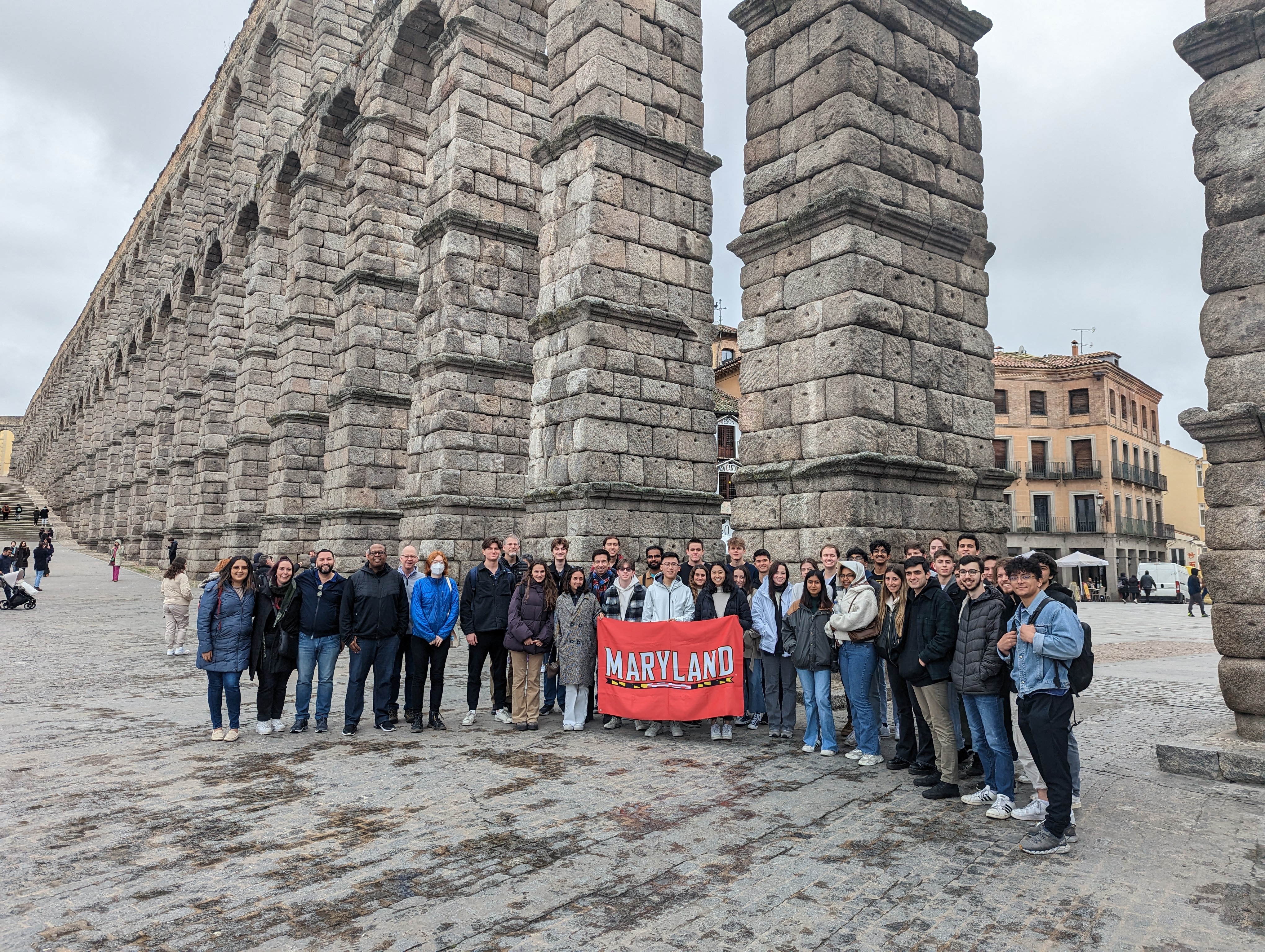
The Clark in Madrid Program offers approved engineering coursework in all 9 engineering majors, business, computer science, and information studies allowing for Fall, Spring and Full-Year study abroad opportunities. It is the largest study abroad program managed by the University of Maryland and provides robust intercultural and interdisciplinary experiences for University of Maryland students both in and outside the classroom.
Top