News Story
Student Spotlight: Outstanding Junior Award Recipient Joel Thomas
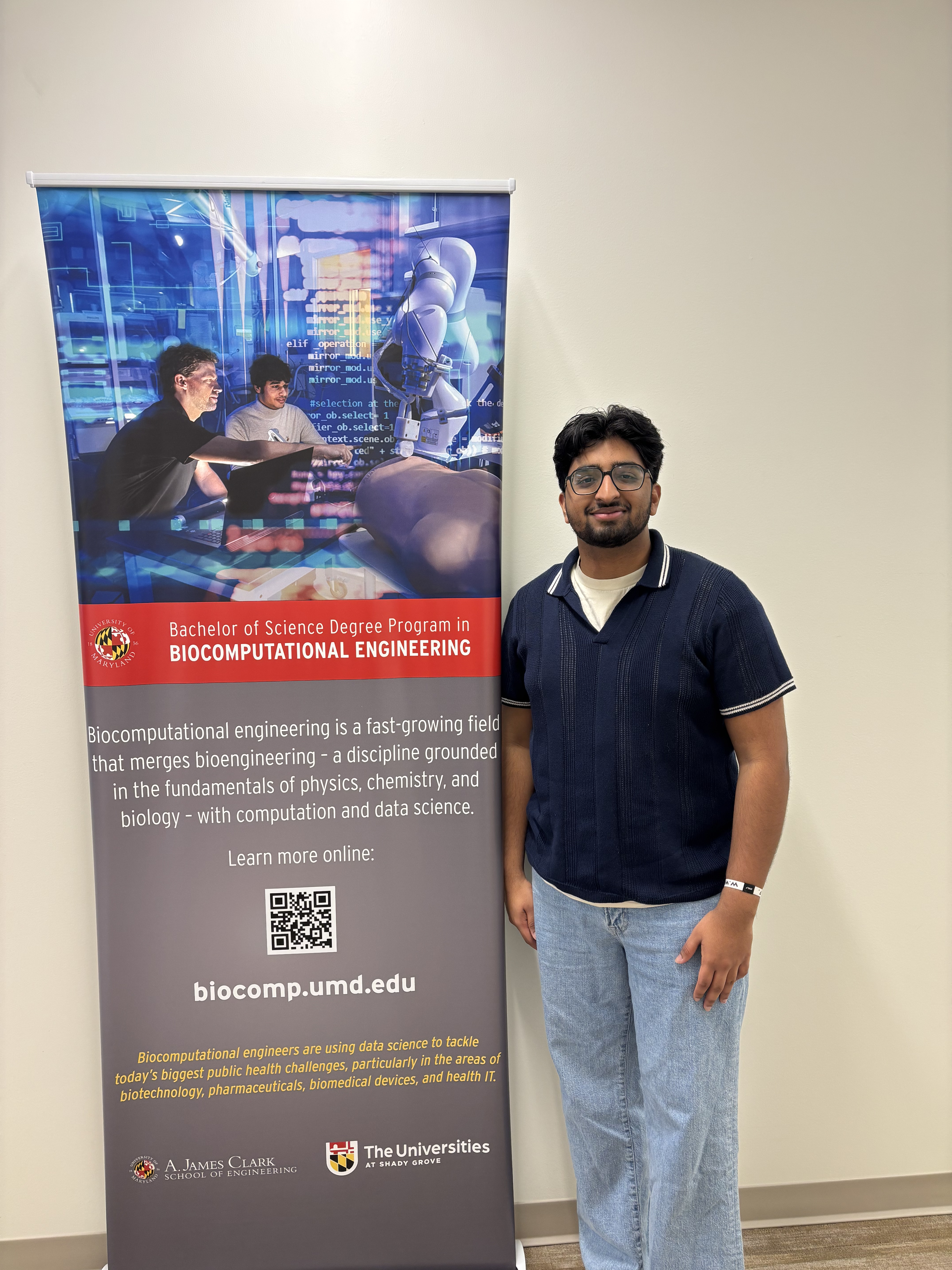
For Joel Thomas, biocomputational engineering offered the perfect opportunity to combine his interests in healthcare, programming, and data science into one interdisciplinary field. Now a junior in the Fischell Department of Bioengineering’s Biocomputational Engineering (BCE) program at the University of Maryland, Thomas is building experience in cancer research, medical imaging, and artificial intelligence–exploring how computational tools can improve patient care and drug development.
Thomas discovered the BCE program during the summer before his senior year of high school while researching computational biology programs across the country. Maryland's engineering-focused approach immediately stood out, particularly for its strong emphasis on math, coding, and real-world healthcare applications.
In recognition of his academic achievement and research contributions, Thomas was selected to receive the Fischell Department Outstanding Junior Award, one of the department’s highest honors for undergraduate students.
“Receiving the Outstanding Junior Award was a very meaningful and humbling honor for me,” he says. “It reflects not only my academic work, but also the support and encouragement I’ve received from mentors, faculty, family, and friends along the way.”
Originally interested in medicine, Thomas eventually realized he was more drawn to the computational side of healthcare and the potential for programming and AI to support clinical research and patient outcomes.
“I can still be involved in healthcare, but through applying programming skills and technology to solve problems,” he says.
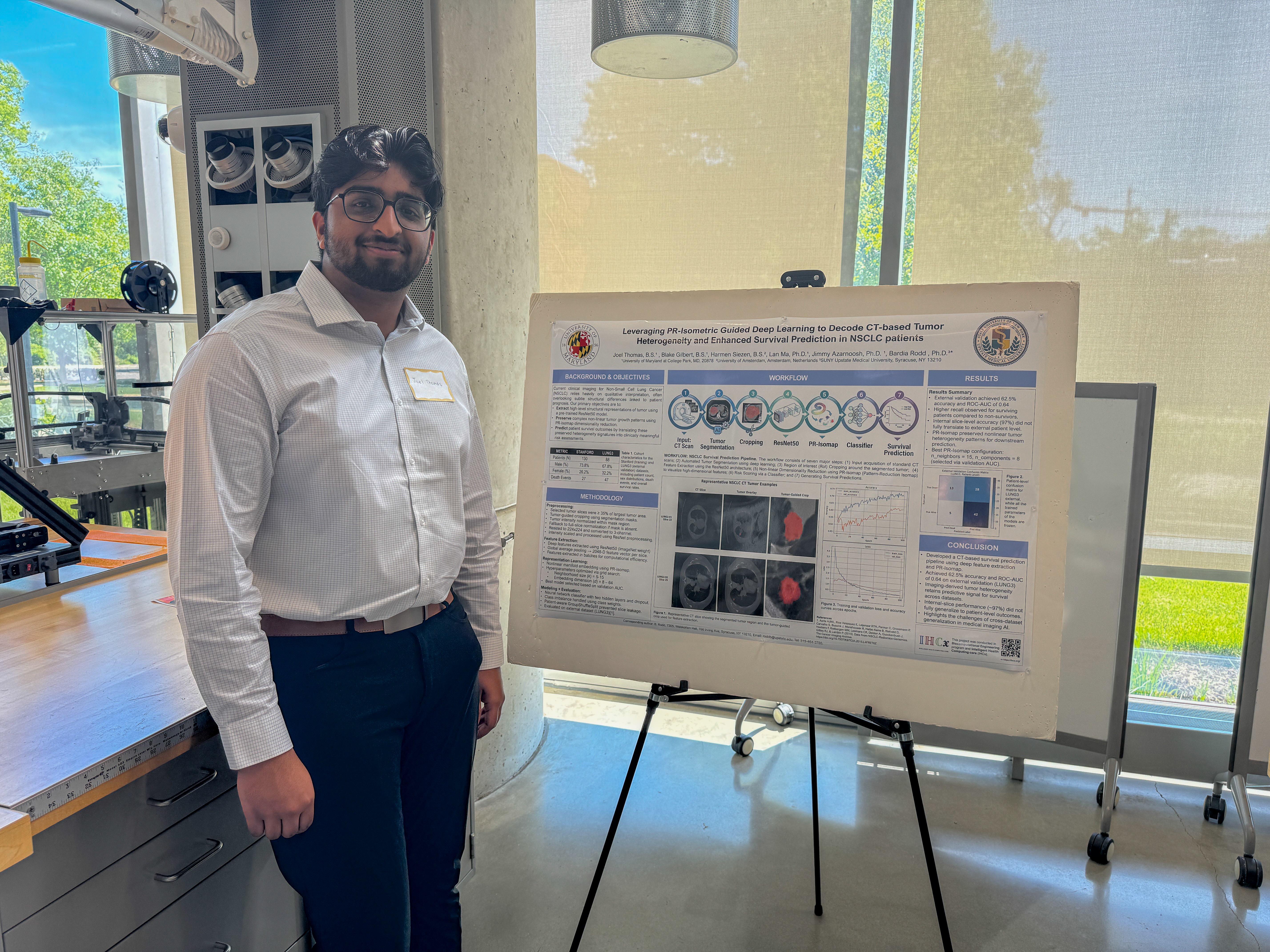
That interest has shaped both his coursework and research experiences at Maryland. Since January 2025, Thomas has worked with Dr. Bardia Rodd at SUNY Upstate Medical University on cancer-focused research projects involving breast and lung cancer datasets. After beginning with statistical analysis on breast cancer data, he transitioned into a larger lung cancer project using CT scans and artificial intelligence models to predict patient survival outcomes.
“This is honestly everything I dreamed of doing. I’m getting exposure to clinical research, different types of data, and how AI can be used to better understand whether treatments are actually working.”
-Joel Thomas
“Imaging was always something I was really interested in,” he says. “What I learn in class helps my research, and what I learn in research helps me in coursework too.”
Thomas says the collaborative nature of the BCE program has played a major role in his growth as a student and researcher. He credits faculty and staff, including BCE Academic Coordinator Sivan Saravanapavan, BCE Program Director Dr. Lan Ma, and BCE faculty members Dr. Jimmy Azarnoush and Dr. Jared Callura, for helping guide him academically and professionally throughout his time in the program.
"We are impressed by Joel’s deep passion and dedication to broadening his horizons and improving his biocomputational skills through persistently pursuing cutting-edge research,” said BCE Program Director Dr. Lan Ma. “BCE's mission is to foster students with various backgrounds to grow and thrive in the biocomputational field and make meaningful contributions to the community, such as SUNY Upstate Medical University, RISE Therapeutics, AstraZeneca, FDA, IBBR and other partners of the program."
Through those connections, Thomas secured an internship as an AI Data Systems Intern at RISE Therapeutics, where he works with clinical and biological datasets spanning proteomics, metabolomics, RNA sequencing, flow cytometry, and spatial transcriptomics. The role has given him direct exposure to how AI and machine learning are being used to analyze complex data and support drug development for diseases including arthritis, ulcerative colitis, and cancer.
“This is honestly everything I dreamed of doing,” he says. “I’m getting exposure to clinical research, different types of data, and how AI can be used to better understand whether treatments are actually working.”
One area that has especially captured Thomas’s interest is spatial transcriptomics, an emerging field that combines gene expression analysis with spatial information from tissue samples. He hopes to continue exploring this field alongside oncology and imaging research in the future.
Thomas encourages students interested in BCE not to feel discouraged if they do not already have extensive experience in coding or biology before entering the program.
Looking back on his experience so far, Thomas says the motivation and sense of purpose within the BCE community are what stand out most to him.
“Everyone here has something they genuinely want to pursue,” he says. “People are not just here to get through classes. There’s real passion and motivation behind what students are doing.”
Published May 28, 2026
Related Stories
Stories / September 29, 2026
BIOE Celebrates Five Award Recipients at Ninth Annual 2026 EPIC...
Stories / September 15, 2026
Jonathan Portillo Conducts Success as Fire Protection...

Stories / August 4, 2026
Kuo Lab Hosts Future Bioengineers
Stories / July 13, 2026
Meet the Newest Cohort of the MARC Program

Stories / June 5, 2026
UMD Senior Joshua Mathew Wins 2026 Astronaut Scholarship

Stories / June 2, 2026
Wielgosz Receives ARCS MWC Foundation Scholarship

Stories / May 29, 2026
BIOE Announces Spring 2026 Instructional Impact Awards
Stories / May 15, 2026
BIOE Students Recognized for Innovative Healthcare Solutions at...
Stories / May 13, 2026
2026 Invention of the Year: Engineering Projects Top List

Stories / May 13, 2026
Capstone Design Expo 2026: Students Solve for Maryland & Beyond