News Story
2026 Invention of the Year: Engineering Projects Top List

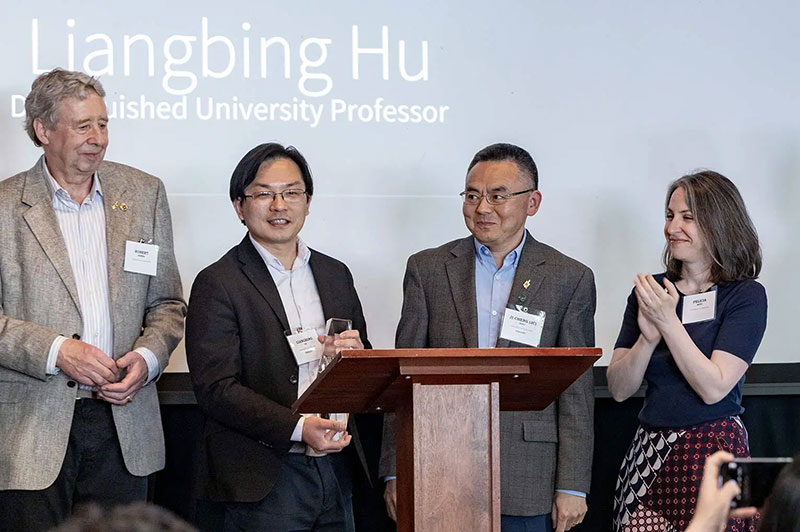
Researchers from the A. James Clark School of Engineering led—or participated in—projects awarded by University of Maryland’s as the 2026 Inventions of the Year.
A team of eight inventors—including seven from the Clark School and one from the University of Maryland School of Medicine—was named the Overall Winner and topped the Life Sciences category.
Engineers were also key inventors in the winners of the Information Sciences and Quantum categories; an engineering faculty inventor was one of two UMD faculty members to receive special recognition for significant contributions to the university’s innovative ecosystem; and engineering students were recognized for their innovative projects.
The awards were announced Tuesday, May 12 at Innovate Maryland, an annual celebration of UMD researchers’ creativity in translating cutting-edge research into practical, impactful solutions.
“Our researchers are redefining what's possible across science, medicine and technology,” said Vice President and Chief Research Officer Patrick O'Shea. “From pulling 'forever chemicals' out of our drinking water to harnessing the power of quantum light, this year's finalists remind us that bold ideas and rigorous science can change lives and the world.”
Invention of the Year: Overall & Life Sciences Category
Antigen-Specific Immune Tolerance (ASIT): Recalibrating the Body’s Defense Against Autoimmune Disease
- Engineering faculty: Christopher Jewell, Emily Gosselin, Senta Kapnick
- Engineering students: Sean Carey, Ryan McIlvaine, Christopher Bridgeman, Robert Oakes
- Medical faculty: Jonathan Bromberg
What if the body’s immune system could be rewired not to attack itself—the same way a smoke alarm can be recalibrated to stop going off when there’s no fire?
A team of University of Maryland researchers has developed a therapy to do exactly that. This ASIT technology creates microparticle “depots” injected directly into the lymph nodes—the body’s immune command centers—to correct how cells decide what to attack and what to leave alone. A single dose produces strong, long-lasting effects, and early results suggest it may even be able to repair tissue that has already been damaged by disease.
“This concept represents a major shift in how we think about treating autoimmune disease and is the result of the hard work of a fantastic group of researchers,” said principal investigator and Robert E. Fischell Institute Professor for Translational Medicine Christopher Jewell. “Instead of suppressing the immune system non-specifically, we’re teaching it to just correct dysfunctional response and leave healthy immune function intact.”
Autoimmune diseases affect millions of people worldwide, yet most current treatments rely on broad immune suppression that leaves patients more vulnerable to infections and complications while doing little to address the underlying cause. ASIT takes a different approach, creating tolerance-inducing hubs that work locally to rebalance the immune system without further damage.
The therapy has shown promise for a wide range of conditions, including type 1 diabetes, multiple sclerosis, celiac disease, vitiligo and transplant rejection.
Information Sciences Category Winner
Teaching Human Fine Motor Skills to Robots via the RAND Laser System
- Engineering faculty: Yang Tao
- Engineering students: Anjana Hevaganinge, Ravidu Hevaganinge
- Physics researcher: Joshua Ehizibolo
Training a robot to do what human hands do naturally—peel a shrimp, suture a wound, harvest a strawberry—has long required enormous amounts of data, expensive equipment and still-unreliable results.
The RAND Laser System, developed by researchers in the A. James Clark School of Engineering and the College of Computer, Mathematical, and Natural Sciences, cuts through the complexity with a single demonstration. A camera and laser grid capture human motion, extract key waypoints and map them to the robot’s workspace—no massive dataset required.
In testing, the system achieved 75% success in tasks as delicate as extracting crab meat, a result comparable to a non-expert human. The implications stretch from surgical robotics to food processing to agricultural harvesting.
Quantum Technology Category Winner
Topological Photonics Architecture for Optical Computing and Artificial Intelligence (TOPAI)
- Engineering & physics faculty: Mohammad Hafezi
- Physics researchers: Mahmoud Mehrabad, Lida Xu, Supratik Sarkar, Zhi-Yuan Wei
Today’s AI systems are bumping up against hard limits. They consume enormous amounts of power, generate tremendous heat and struggle to scale.
TOPAI, developed by researchers in the College of Computer, Mathematical, and Natural Sciences and the A. James Clark School of Engineering, offers a different approach: computing with light instead of electricity.
Like a train locked onto a track, TOPAI’s topological photonic states keep information stable and on course even as the system scales, opening a new frontier for AI infrastructure that is faster, cooler and more resilient than ever before.
Engineering Professor Named Entrepreneur of the Year
Srinivasa Raghavan, professor of chemical and biomolecular engineering and fellow at the Robert E. Fischell Institute for Biomedical Devices, received the Entrepreneur of the Year Award for his exceptional record of translating research into real-world impact through startup creation and technology commercialization.
Raghavan has co-founded three startup companies—Medcura, Grip Boost and Gelectric—with appointments spanning the Brain and Behavior Institute, the Fischell Department of Bioengineering, the Robert E. Fischell Institute for Biomedical Devices and the Maryland Energy Innovation Institute.
Recognition for Engineering Students
The University of Maryland also recognized two student engineering design projects that approach everyday challenges with innovation that’s literally hands-on.
One team developed an assistive grooming device that enables people with disabilities to independently brush or style their own hair.
Another integrated auditory cues into rock climbing holds, helping climbers with visual impairments identify routes and navigate moves with greater confidence.
Both projects were supported by industry mentor Steve Bailey of the IMAGE Center of Maryland and faculty advisers Miao Yu and David Bigio, professors of mechanical engineering, with students Nasya Anderson and Trung Ngu.
Additional Winners from UMD
Cell Biologist Molecular Geneticist Receives Innovation Catalyst Award
Anne Simon, professor of cell biology and molecular genetics, received the Innovation Catalyst Award for spurring innovation on campus and in industry. Simon co-founded Silvec Biologics with her brother Rafael Simon to deploy her research against citrus greening disease—a bacterial infection that has devastated Florida's citrus industry since 2005 and continues to threaten production worldwide.
Physical Sciences Category Winner
Rare-Earth Metal Ion Recovery Using a Self-Assembling Ligand System
- Chemistry & biochemistry faculty: Mercedes Taylor, Michael Baptiste
The rare-earth metals used to build our phones, electric vehicles and renewable energy systems are extraordinarily difficult to recover and recycle. Traditional extraction methods are slow and chemically intensive and often yield impure results. Researchers in the College of Computer, Mathematical, and Natural Sciences have designed a molecule that solves this problem by self-assembling around rare-earth ions to selectively bind and separate them from complex mixtures. The process is rapid, recyclable and precise, with the potential to build a more sustainable and reliable supply chain to support clean energy infrastructure.
This article was adapted from Body Defense Bootcamp: Therapy to Retrain Immune System Named UMD’s 2026 Invention of the Year by Silvana Montañola M.A. ’23.
Published May 13, 2026
Related Stories
Stories / May 13, 2026
Capstone Design Expo 2026: Students Solve for Maryland & Beyond
Stories / September 3, 2026
UMD Convocation will honor five from the Clark School
Stories / August 26, 2026
Graham Named Honorary ASME Member

Stories / August 25, 2026
NSF Renews Maryland-Led Quantum Simulation Institute’s Funding

Stories / May 29, 2026
BIOE Announces Spring 2026 Instructional Impact Awards
Stories / May 11, 2026
Undergrads Recognized at Annual Honors & Awards Celebration

Stories / April 24, 2026
Pines elected to American Academy of Arts and Sciences

Stories / February 23, 2026
BIOE Announces Fall 2025 Instructional Impact Awards
Stories / June 16, 2025
BIOE Announces Spring 2025 Instructional Impact Awards
Stories / May 2, 2024
Groundbreaking Plasma Innovation Shines as Invention of the Year