News Story
AI-Powered Hybrid Model Could Boost HVAC Efficiency

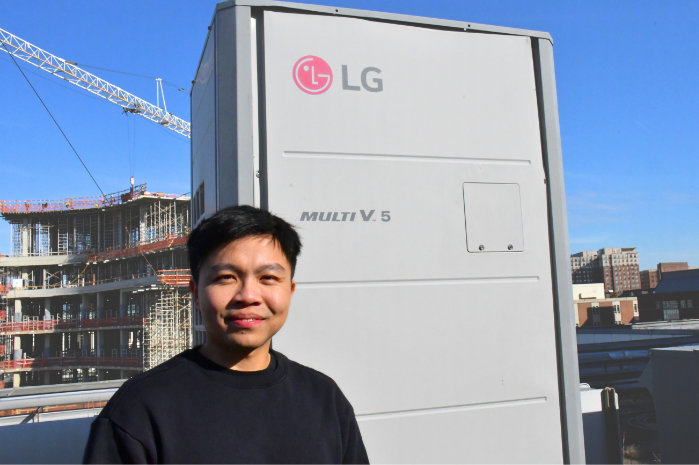
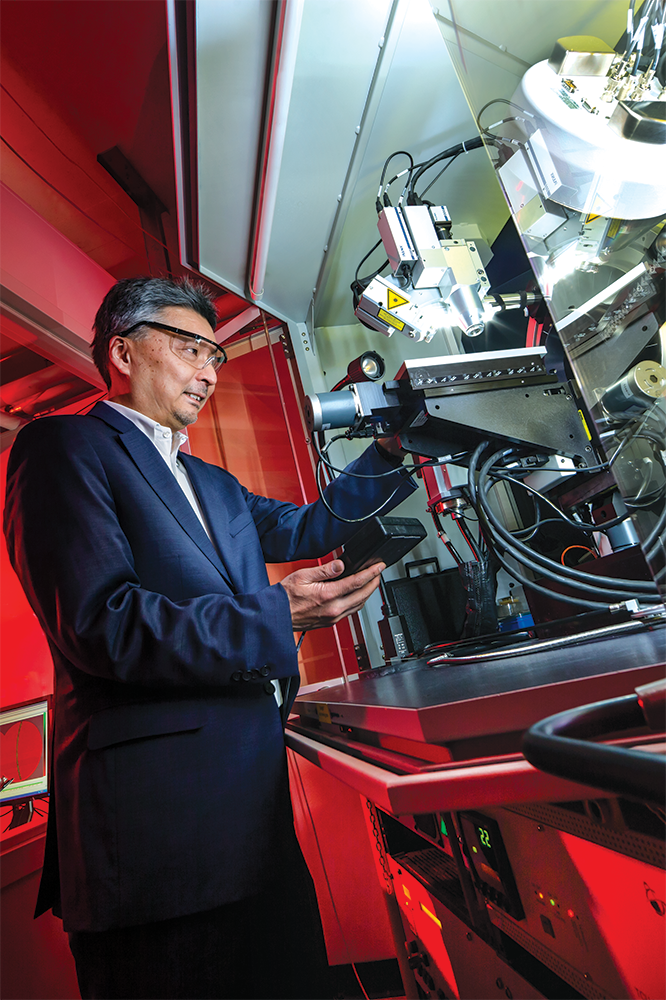
A CEEE team developed a hybrid modeling framework for HVAC systems that combines AI and physical models to optimize energy efficiency. Lead author Po-Ching Hsu is shown with the outdoor unit of a system the team studied to collect data for the model.
Nearly half of a building’s energy goes to heating and cooling, but machine learning could help cut that consumption. The catch: Machine-learning models are only as good as the data used to train them. To get around this limitation, a UMD Center for Environmental Energy Engineering (CEEE) team has developed a hybrid model that combines data-driven and physical models.
In the April 1, 2026, issue of Energy and Buildings, CEEE researchers propose a hybrid modeling framework for variable refrigerant flow (VRF) HVAC systems to improve energy efficiency, without compromising thermal comfort.
The hybrid model builds on the team’s earlier machine-learning models, which integrate HVAC data, building conditions and short-term weather forecasts to optimize system performance. But those models falter in extreme temperatures, which are rarely seen in College Park and therefore largely missing from the data.
“Data-driven models are very accurate if you get enough data, which is usually not the case in reality,” says lead author Po-Ching Hsu, a CEEE graduate research assistant and a mechanical engineering Ph.D. candidate. Research Professor Yunho Hwang, director of CEEE’s Energy Efficiency and Heat Pumps consortium, is co-author.
"Data-driven models are very accurate if you get enough data, which is usually not the case in reality."
Po-Ching Hsu, CEEE graduate research assistant and mechanical engineering Ph.D. candidate
In contrast, physical-based models require less data but more computational power and modeling resources. “After reviewing these two types of models,” Hsu says, “I started thinking maybe I can combine them to get a model that’s very accurate and has high computational efficiency.”
A typical VRF system consists of one outdoor unit connected to multiple indoor units serving different thermal zones within a building. For this study, the team developed a virtual VRF system using real-world data collected from field tests on a VRF system in the university’s Glenn L. Martin Hall, which includes an outdoor unit and seven indoor units.
The hybrid model proved highly accurate at predicting indoor-unit capacities and total power consumption, which helps to optimize energy efficiency. It maintained robust performance even under data-scarce conditions, outperforming conventional machine-learning models. The model’s predictions closely matched real system measurements, with typical errors of just 5–6%. As a next step, the researchers are working to test whether the system can scale and perform reliably across different VRF systems and operating locations.
Download the paper: “Hybrid machine learning–physics-based modeling and model predictive control of variable refrigerant flow systems in buildings.”
Published March 18, 2026
Related Stories
Stories / March 23, 2026
UMD to Lead DARPA-Funded Effort to Accelerate Mathematical...

Stories / March 13, 2026
UMD-Developed AI Tool Advances Building Decarbonization and...

Stories / July 24, 2025
UMD Study Compares AI Models for HVAC Systems, Highlighting...
Stories / November 5, 2024
CEEE Study Explores How AI Can Reduce HVAC Energy Consumption
Stories / December 17, 2019
AlphaGo family of AI programs grew from AMS simulation-based...

Stories / September 17, 2019
Advancing Healthcare through Robotics and Machine Learning
Stories / July 10, 2019
The Battery Revolution

Stories / April 11, 2019
Algorithms and Autonomous Discovery
Stories / April 9, 2019
Machine Learning's Translational Medicine
Stories / April 4, 2019
Measuring Change in the Atmosphere