News Story
Christmas Tree Burning Demonstrations Shed Light at Fire Hazards During the Holidays
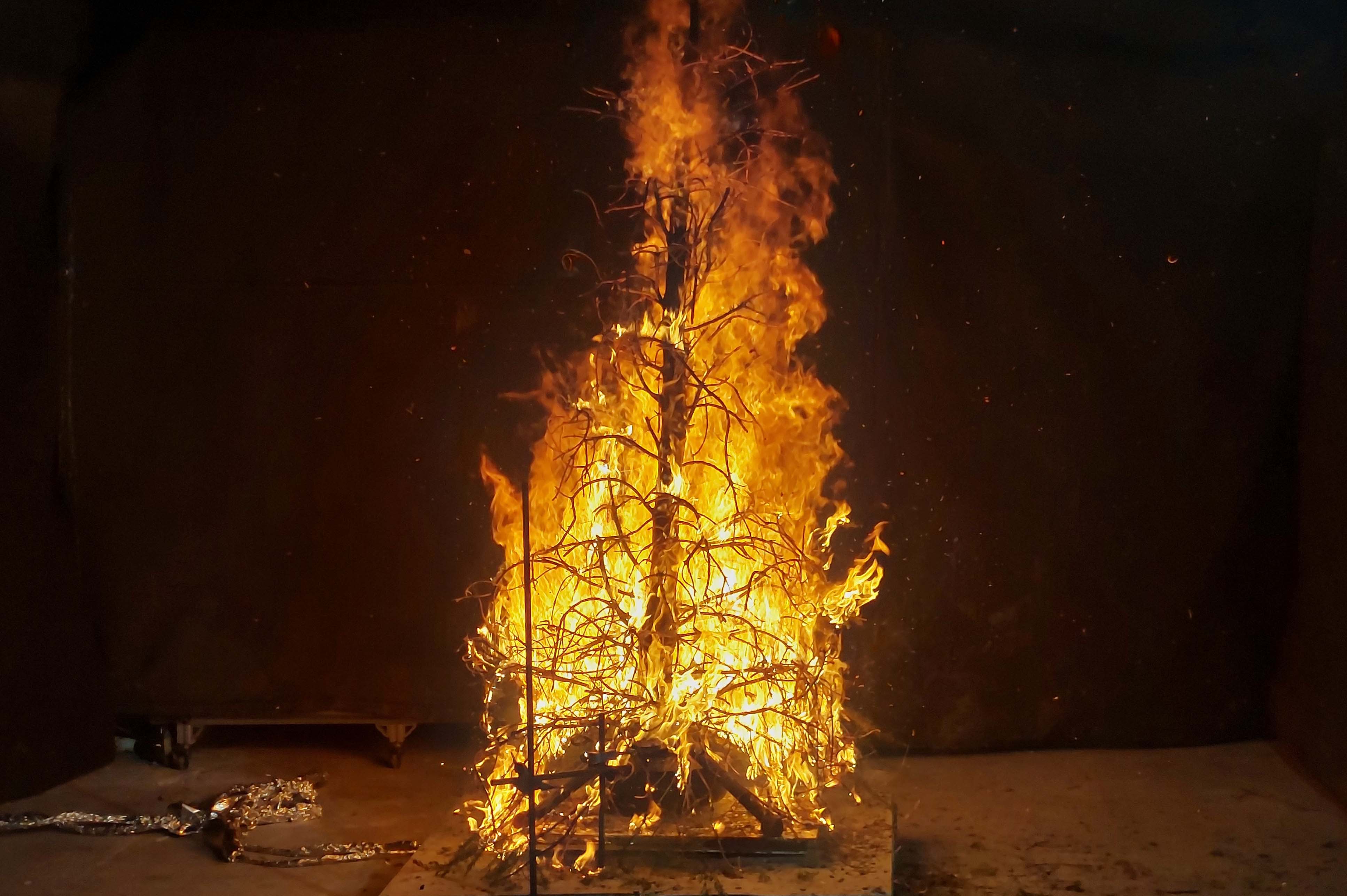
The Department of Fire Protection Engineering (FPE) held its annual Christmas Tree Fire Safety Demonstration on Wednesday, December 17, 2025 in an effort to raise awareness of this seasonal fire risk with the potential for the deadliest of outcomes.
At the Koffel Associates Fire Standards Laboratory, Isaac Leventon, a research scientist with the National Institute of Standards and Technology (NIST), and an FPE adjunct lecturer, conducted a series of live fire experiments demonstrating the burning behavior of well-hydrated Douglas-Fir trees in comparison to unhealthy, dried out ones. Each year, Leventon seeks to educate the public about the hundreds of fire incidents that repeatedly result in structural losses and civilian casualties.
“Though Christmas tree fires are not the most common fire events in the home, they are particularly dangerous because a dry, natural Christmas tree fire can be very large and grow exceptionally quickly. These demonstrations help to illustrate the importance of keeping your tree healthy and well-watered to reduce the risk of ignition and limit the potential for fire growth,” said Leventon.
According to the National Fire Protection Association (NFPA), between 2018-2022, United States fire departments responded to an estimated average of 155 home structure fires per year caused by Christmas trees. These fires caused an annual average of four civilian deaths, seven civilian injuries, and $15 million in direct property damage. Although, current statistics indicate that the number of Christmas tree fires has significantly decreased over the years according to a 2022 NFPA study—from a high of 850 in 1980, to 270 in 1998, to 160 more recently, Christmas tree fires are particularly challenging to life safety, and represent an outsized impact on direct property damage.
A 2017 NFPA report found that home structure fires that started with the ignition of a Christmas tree were nearly 4.5 times more deadly than those caused by the burning of any other item. This underscores the importance of maintaining safety practices in place when decorating your home for the holiday season.
The tests demonstrated the impact of moisture content on ignitability, fire growth rate, and peak fire size, otherwise known as Heat Release Rate (HRR), emphasizing how these accidents can be prevented by following the safety measures recommended by the NFPA.
A subsequent round of experiments on the same day at noon engaged fire safety scholars, students, and engineers in a friendly competition to predict the burning behavior of the trees. This year marks the competition’s 12th anniversary; last year’s event drew 185 participants from across 29 nations and 11 states in the U.S. FPE students were also invited to join these demonstrations to experience (in-person) fundamental fire phenomena that they study in their classes (such as, Fire Dynamics, Heat and Mass Transfer, Wildland Fires).
In the News
-
Fire safety experts warn of dry Christmas tree dangers this holiday season – WMAR
-
UMD shows dangers of dry Christmas trees during the holiday season – WBAL
-
Watch what happens if you stop giving your Christmas tree water – WTOP
Published December 19, 2025
Recent Stories
Stories / Sep 23, 2026
Alchemity receives Breakthrough Energy Fellowship

Stories / Sep 22, 2026
Two Years Running, Maryland #12 Among Publics for Undergrad...

Stories / Sep 21, 2026
Ribbon-cutting Celebrates Baltimore Center Where Engineers,...

Stories / Sep 21, 2026
Wu Receives IEEE Sensors Council Technical Achievement Award

Stories / Sep 16, 2026
New Faculty Members for 2026-27 Engineer for the Public Good

Stories / Sep 15, 2026
Professor Lucy Qiu weighs in on statewide policy for data...

Stories / Sep 15, 2026
Honoring Achievement: Celebrating Latine Heritage Month

Stories / Sep 15, 2026
Tabatha Cuadra Rodriguez: Community Advocate

Stories / Sep 15, 2026
Jonathan Portillo Conducts Success as Fire Protection...

Stories / Sep 14, 2026
ACS Recognizes Chemical Engineer with Leadership in Mentorship...
