Cooling data centers with better, safer two-phase fluids
UMD engineers usher in AI’s “cool” revolution: innovative technology to reduce the power and water usage of AI data centers.
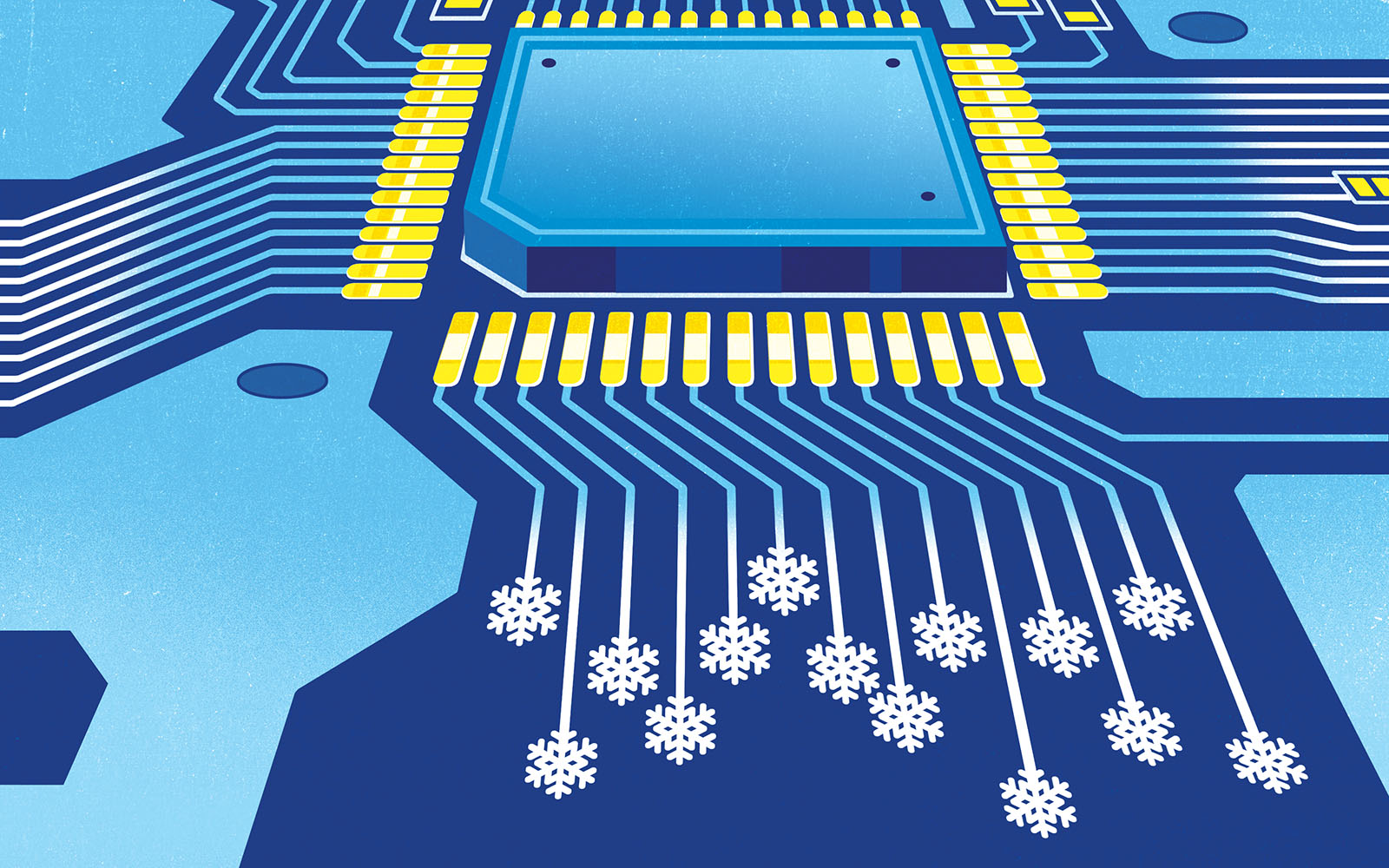
UMD engineers usher in AI’s “cool” revolution: innovative technology to reduce the power and water usage of AI data centers.
The computing that powers AI systems generates significant heat, and keeping data centers cool is a perennial challenge for the industry. Around 80% of data centers rely on air cooling, in which chilled air is piped up through building floors and passed through the racks of servers.
The air is cooled in a chiller by a spray of water droplets that evaporate as they absorb the building’s heat—meaning the center needs an ongoing supply of new water to keep the equipment from overheating. An average data center that relies on evaporative cooling towers can use as much water annually as a small city.
Damena Agonafer, associate professor of mechanical engineering and Clark Faculty Fellow, warns that air cooling isn’t sufficient to cool next-generation graphics processing units (GPUs): “Ever-more sophisticated AI will require high-performance, high-power-consumption GPUs,” he says. “More powerful chips mean more heat generation. Therefore, we’re going to need some serious innovative cooling technology.”

Agonafer’s research interest is at the intersection of thermal-fluid sciences, interfacial transport phenomena, and renewable energy.
Liquid cooling—where cooling water or other liquids are continuously recirculated in a closed circuit, limiting evaporation into the environment—is a superior environmental choice.
More effective still is two-phase cooling, which uses liquids that turn to vapor as they absorb heat from the GPUs, a process that allows the fluid to remove far more heat, in an energy-efficient manner.
These fluids are circulated via cold plates—inserts typically made of metal that are integrated into the server rack on top of the GPUs, like icing between layers of a cake. The fluids pass through channels in the cold plates, absorbing heat from the equipment, evaporating, recondensing, and beginning the process anew. The technique, called direct-to-chip cooling, is far more efficient than air cooling and can vastly reduce the industry’s power and water use.
Two-phase fluids commonly used in direct-to-chip cooling (such as refrigerants classified as PFAS, or “forever chemicals”) can have deleterious environmental consequences.
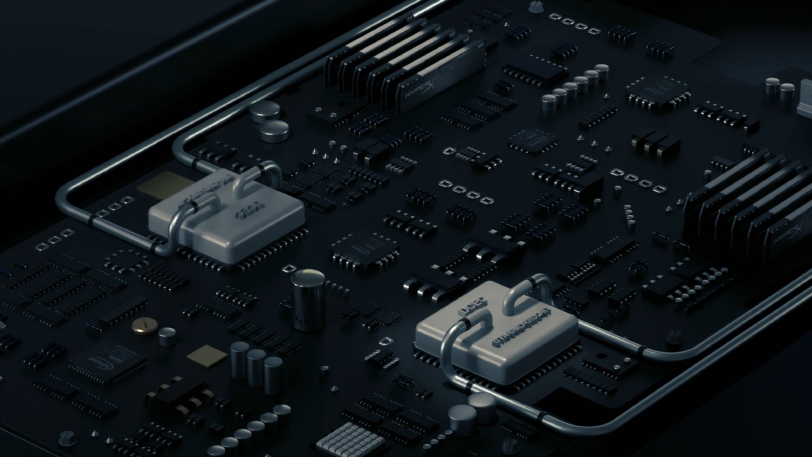
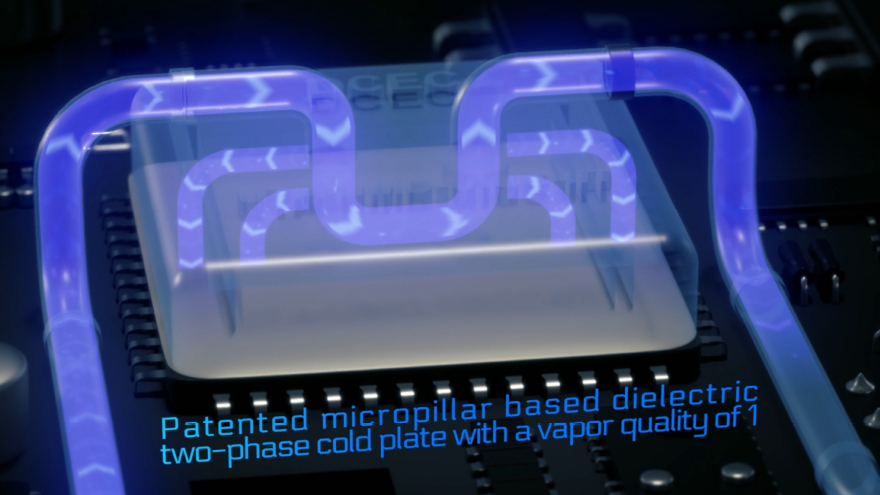
Renderings of Agonafer’s system. Heat-extracting cold plates are placed in direct contact with computer chips. A liquid coolant flows through these plates to reduce the thermal resistances, allowing above-ambient coolant temperatures and reducing total data-center energy usage by 25–35%.
Agonafer is identifying better, safer two-phase fluids as part of his work with the Environmentally Applied Refrigerant Technology Hub (EARTH), a highly competitive National Science Foundation-funded Engineering Research Center (ERC) initiative that pools the talents of six engineering schools.
These fluids will be tested in novel two-phase cold plates Agonafer and his team have been developing with support from the COOLERCHIPS program of the Advanced Research Projects Agency–Energy (ARPA–E), a division of the Department of Energy that funds innovative technologies.
As these innovations are adopted, EARTH also may help develop infrastructure to train the next generation of HVAC technicians in maintaining more sustainable data centers.
View all: Engineering AI for the Public Good