News Story
UMD Team Secures $200,000 to Commercialize Wearable Vascular Monitor

A wearable smart-patch device developed at the University of Maryland to protect the lifeline of hemodialysis patients is moving from the lab toward the clinic, thanks to two recent awards.
The team behind the device, called VASPatch, received a $180,000 Maryland Innovation Initiative (MII) Technology Assessment Grant from TEDCO to advance the device toward commercialization, and was awarded the first-place $20,000 Steven H. Krosnick Prize, funded by the National Institute of Biomedical Imaging and Bioengineering, at the 2026 Design by Biomedical Undergraduate Teams (DEBUT) Challenge.
Vascular access is essential for patients with end-stage renal disease. However, current long-term access options, including arteriovenous fistulas and grafts, often fail unpredictably due to blood clots and vessel narrowing.
What makes this problem severe is timing. After an access is surgically created, problems can develop silently. This can lead to sudden acute failures during the 44- to 68-hour window between dialysis sessions, when patients are not under clinical observation. By the time patients arrive for their next treatment, a blockage may have already formed, creating a cascade of complications: patients can require emergency interventions, temporary central venous catheters, or additional surgeries to create new access sites, all of which increase healthcare costs and mortality risk for an already disproportionately expensive and underserved patient population.
"Vascular access is the lifeline of hemodialysis, yet current standard-of-care monitoring depends almost entirely on unreliable self-reported symptoms or reactive in-clinic exams, requiring trained personnel. In reality, most of a patient's time is spent unmonitored outside of the clinic," explains Jeremy Yun ’26, the team lead. "VASPatch is designed to fill that critical gap between visits with continuous, automated monitoring that patients can use at home."
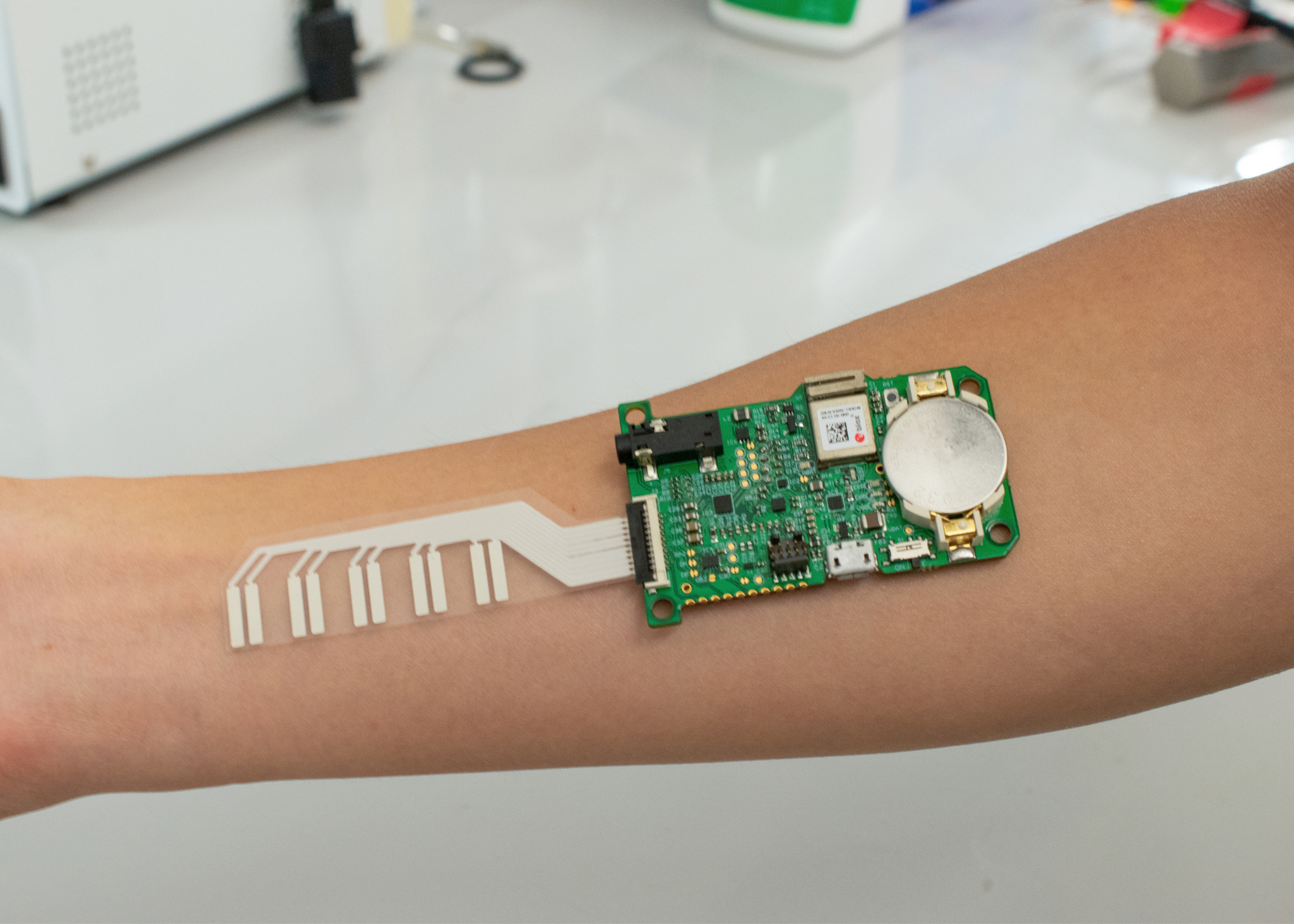
VASPatch is a non-invasive adhesive patch that uses bioimpedance plethysmography, which measures how a small electrical signal travels through tissue, along with embedded algorithms to track vascular access health. With each heartbeat, blood surging through the access shifts the tissue’s electrical resistance, and those shifts follow blood flow. Unlike the optical sensors in smartwatches, bioimpedance is not limited by vessel depth, skin tone, or ambient light, and unlike ultrasound, it does not require a trained operator. The team is now validating whether these signals can flag early signs of narrowing before a dangerous blockage forms.
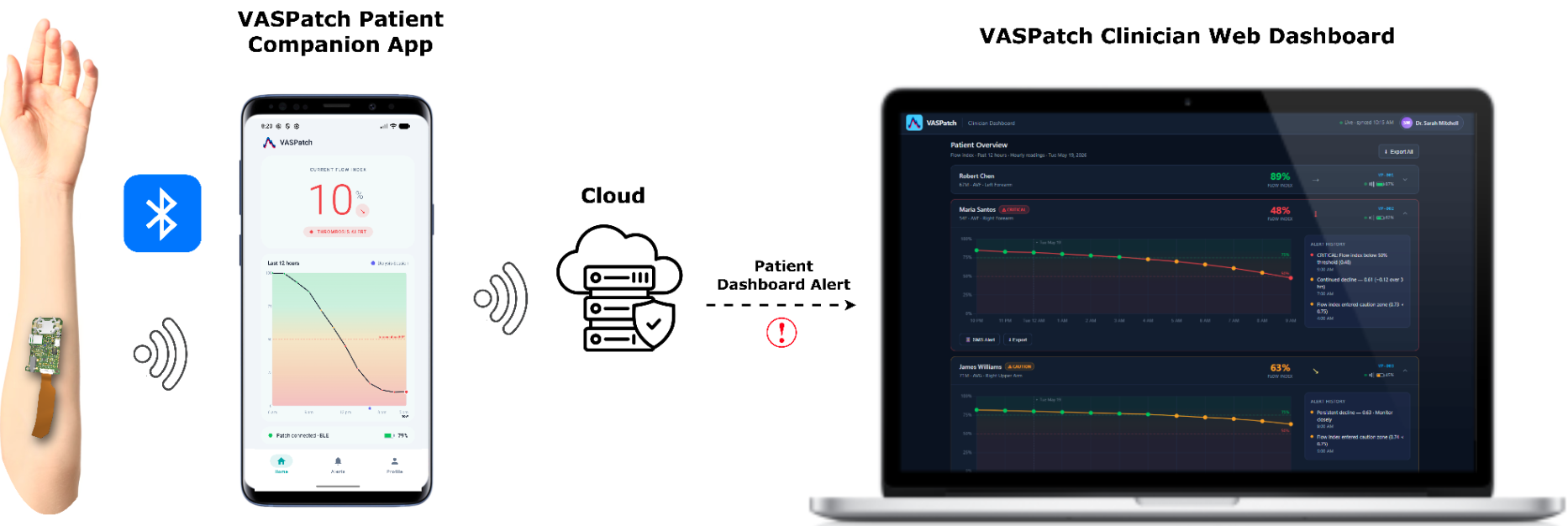
The VASPatch system pairs a disposable electrode patch with a reusable, rechargeable hub that processes signals on the device itself, filtering out noise and motion to extract a "flow index" every three hours. Only that result is sent over Bluetooth to a patient app and a clinician dashboard, preserving battery life and privacy while alerting care teams when a trend warrants a closer look.
“Right now, hemodialysis patients are monitored less than 7% of the time,” said Yun. "When I interviewed patients, they described their access as a prison, a ticking time bomb they carry between sessions. Many feel they've lost control of their own lives. If we can simply tell them how their access is doing, and bring a piece of the clinic to them instead of the other way around, we can give some of that control back. Catching problems earlier could also mean fewer emergency surgeries and hospital stays.”
“Half of all hemodialysis patients will see their new fistula or graft fail within the first year, and it usually happens when they're at home, so we find out only after it's too late to salvage,” said Dr. Matthew Weir, head of nephrology at the University of Maryland School of Medicine and co-investigator on the MII grant. “Many of these patients end up in the hospital or need a temporary tunneled catheter, which carries its own placement and infection risks. Identifying access at risk of closure early, while treatment can still prevent failure, can reduce complications, save money and improve quality of life for dialysis patients.”
Yun began the project as a freshman doing undergraduate research with Sahil Shah, assistant professor in the Department of Electrical and Computer Engineering (ECE) and an affiliate fellow in the Robert E. Fischell Institute for Biomedical Devices. The project has since grown into a full-time commercialization effort, which Yun now leads as a Fischell Institute MPower Entrepreneurship Fellow and a faculty assistant in ECE. The team has filed a U.S. patent application through UM Ventures, completed customer discovery through a regional NSF I-Corps cohort, and plans to launch a startup to bring the device to market. Rounding out the DEBUT team are Caroline Colangelo ’26, Ian Jackson (BIOE, B.S. ’27) and Mary Barsoum (ECE, B.S. ’28).
"The DEBUT award reflects not just the innovation, but the rigor with which the team approached every aspect of the design and validation process," said Shah. "From the initial clinical need identification through prototype development and validation studies, they demonstrated the kind of systematic thinking that will serve them well in bringing this technology to patients. The MII support lets us take the next real step, which is putting it on patients’ arms."
The MII grant, a joint award to researchers at the University of Maryland, College Park and the University of Maryland, Baltimore, funds a nine-month effort to finalize the next-generation device and validate it in patients. Over the course of the project, Shah, Dr. Weir and Yun will miniaturize and waterproof the wearable, test it against clinical ultrasound in hemodialysis patients at University of Maryland Medical Center clinics, and prepare for early regulatory discussions with the U.S. Food and Drug Administration.
Looking ahead, the team aims to build a modular vascular monitoring platform, adding capabilities such as arrhythmia detection, blood oxygenation, and fluid status for dialysis patients, and adapting the technology to other vascular conditions where early detection of clots and narrowing could improve outcomes, such as surgical bypass grafts.
The DEBUT team will be formally recognized for their DEBUT Challenge award at the Biomedical Engineering Society Annual Meeting, held October 21–24 in Orlando, Florida. Now in its 15th year, the DEBUT Challenge is jointly administered by the National Institute of Biomedical Imaging and Bioengineering and VentureWell. This year's competition drew 119 applications from 64 universities across 25 states and awarded $190,000 across 14 prizes, with VASPatch representing the highest recognition of undergraduate innovation in biomedical design for 2026.
Published October 5, 2026
Recent Stories
Stories / Oct 5, 2026
Shah Lab Advances Ferroelectric-Based Neuromorphic Hardware for...

Stories / Oct 5, 2026
Mueller Lab Receives Two NIH Grants to Advance Low-Cost Cancer...

Stories / Oct 5, 2026
UMD Team Secures $200,000 to Commercialize Wearable Vascular...

Stories / Oct 5, 2026
Celebrating LGBTQ+ History Month 2026

Stories / Oct 5, 2026
Mechanical Engineering Doctoral Student Rho Ma’s Varied...

Stories / Oct 1, 2026
Kelly M. is Learning (and Advocating for Students) by Doing

Stories / Oct 1, 2026
Aerospace Alum Pearl Uva ’26 Lifts Off—and Lifts Others

Stories / Sep 29, 2026
BIOE Celebrates Five Award Recipients at Ninth Annual 2026 EPIC...

Stories / Sep 29, 2026
Optics Breakthrough Could Yield Swifter Communications

Stories / Sep 28, 2026
Searching for ET—One Particle at a Time
