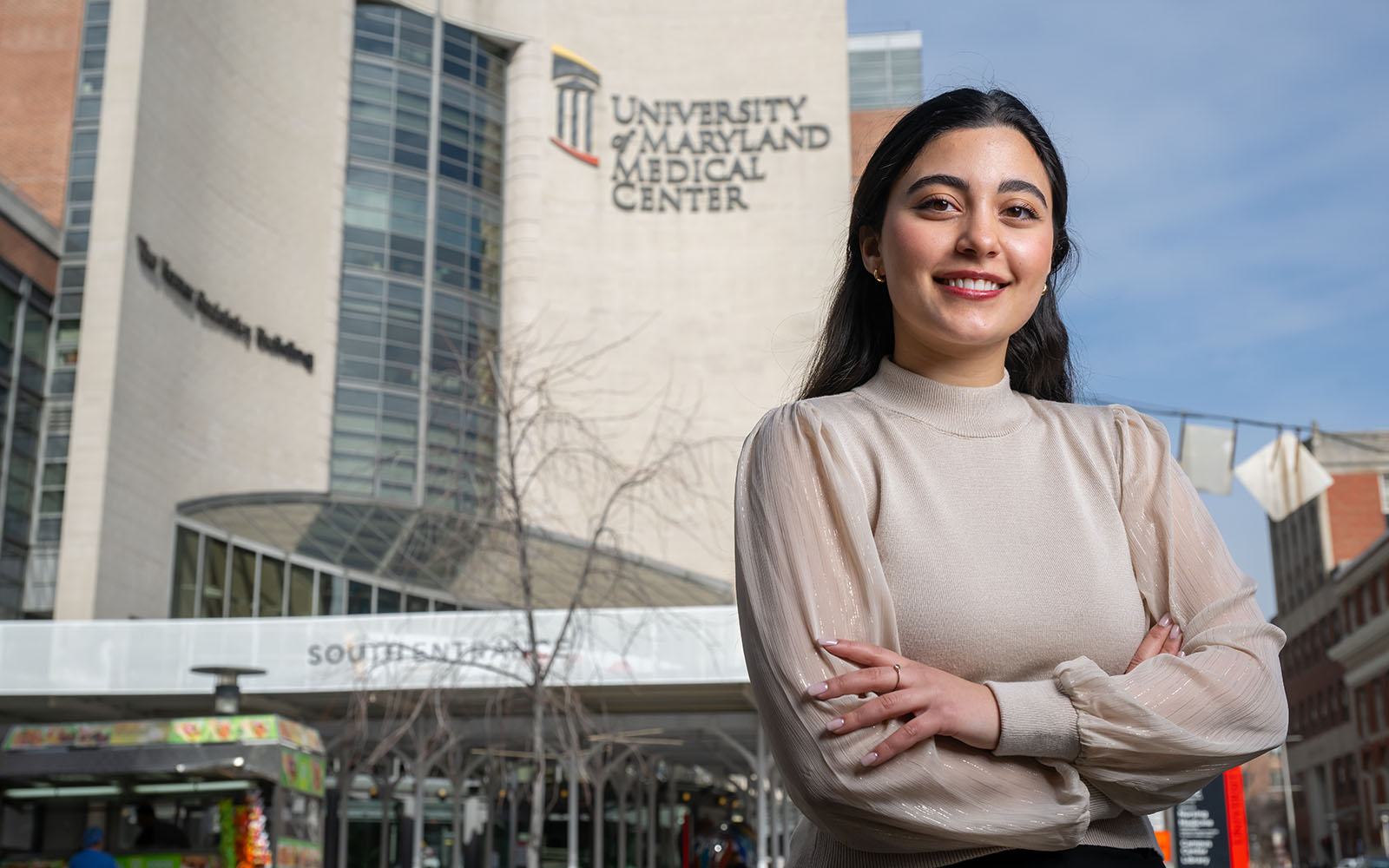
A high school internship researching how to recreate damaged or missing tissue from patients’ own stem cells convinced Nane Manukyan she wanted to be a doctor.
The work had reminded her of her father’s dramatic stories about being a military surgeon, treating soldiers with lost limbs and severe burns, in their native Armenia.
“Being able to help save someone’s life—I feel like, what’s a bigger reward or blessing?” says Manukyan, who grew up in Howard County.
Rather than pursue a traditional pre-med major, such as biology or public health, Manukyan chose bioengineering—and a program at College Park that puts her on a fast track to medical school.
While other universities offer joint B.S.-M.D. programs, UMD’s is one of the first to specifically target engineering, math, and computer science majors.
Medical schools “want more engineers and data scientists combining their interest in innovation, their knowledge of technology, and their passion for practicing medicine,” says Bioengineering Professor Ian White, codirector of the B.S.-M.D. program. “Clinicians need to be on the forefront of understanding what new technology is coming and whether it’s useful or not.”
The program facilitates the research, volunteer work, and clinical experience that Manukyan and her fellow participants will need for their med school applications. It also gives them special access to shadow doctors and network with medical students. If they complete other pre-med requirements, they’ll get a leg up on admission to Maryland’s School of Medicine and can attend straight after college.
The demanding, STEM-heavy course load, on top of a hefty time commitment for off-campus clinical work, requires extraordinarily driven students—the “best of the best,” White says. He expects about 50 applicants annually for the seven spots.
“It’s tough,” he says, “and it’s not for everybody.”
A small program with a strong, compassionate network
Because of that rigor, the program works to build a support network and sense of community among participants. In addition to traveling together to Baltimore for clinical work, B.S.-M.D. students volunteer weekly as a group, playing with children in an after-school program at a shelter for unhoused families.
Manukyan says she appreciates the service work, both because she enjoys helping others and because she believes it will make her a more compassionate doctor.
“Being aware of the communities that you’re part of is important,” she says. “Working with these kids pushes you to be more open-minded and keeps your heart open to listen and understand where others are coming from.”
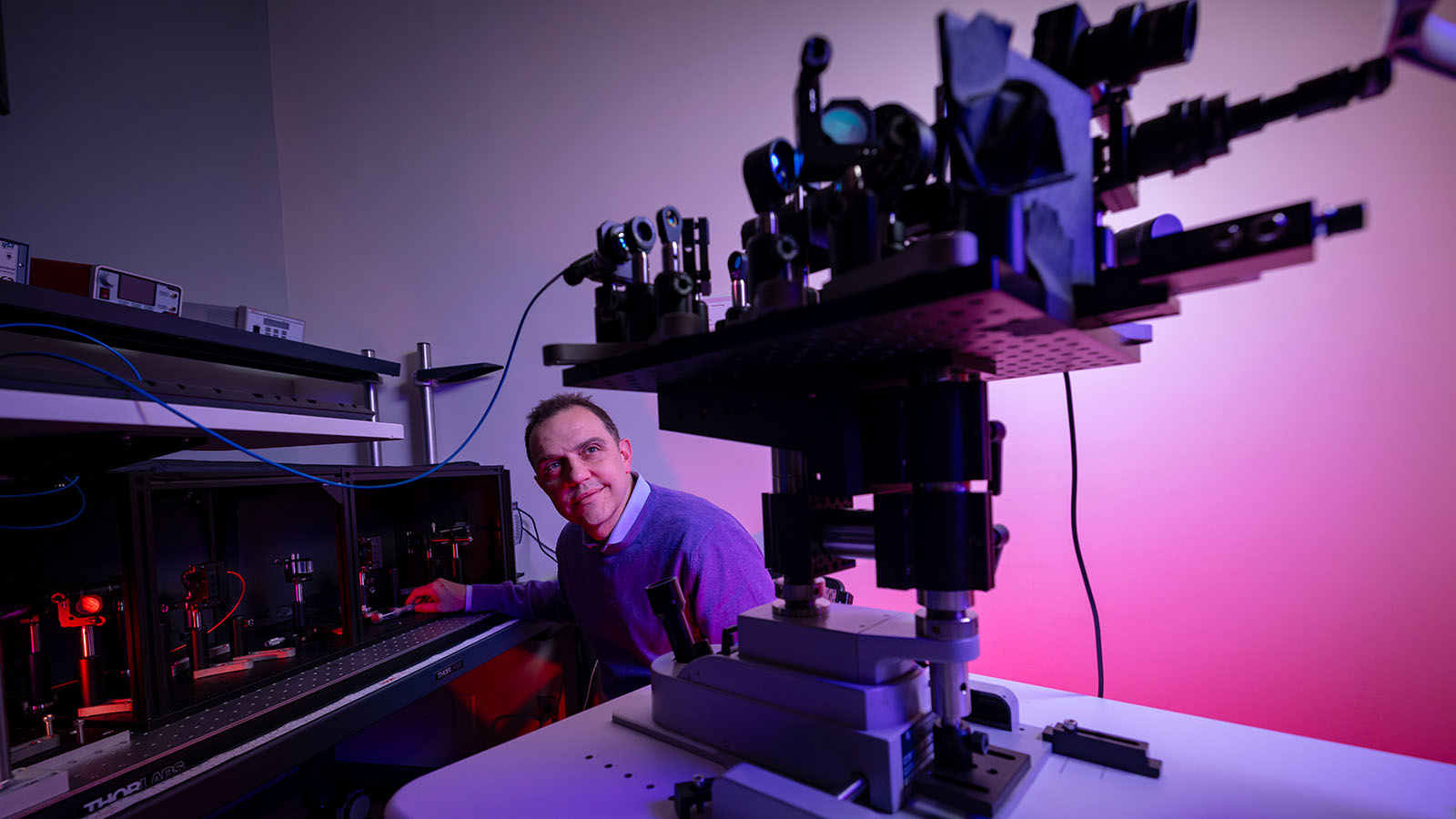 Giuliano Scarcelli welcomes the collaborative atmosphere of the new Edward & Jennifer St. John Center for Translational Engineering and Medicine. (Photo by John T. Consoli)
Engineers make your health care team a dream team
Professor Giuliano Scarcelli firmly believes the maxim that doctors are best positioned to highlight medical problems while engineers are best positioned to solve them.
In Maryland, such collaboration previously suffered from a geographical hurdle: 32 miles between the Baltimore-based medical school and the College Park-based engineering school.
That distance shortened significantly last year with a $10 million gift establishing the Edward & Jennifer St. John Center for Translational Engineering and Medicine. Now, engineers work on Maryland’s School of Medicine campus, joining their clinical colleagues in labs, working down the hall from each other, and sharing insights over lunch or at the gym.
Scarcelli, the center’s codirector, says he’s witnessed how informal, face-to-face interaction can lead to big results. In 2017, his bioengineering office neighbor, Professor Ian White, invited him to join a meeting with visiting med school doctors. They were seeking a device that patients could use at home to monitor their eyes for glaucoma, an irreversible disease that can cause blindness. Together, the group eventually came up with video imaging technology to measure the eyeball’s interior pressure via a pair of glasses.
It’s now in a clinical trial.
“Hopefully,” Scarcelli says, “that’s the kind of collaboration that will become routine with this new model.”