Improving self-driving vehicles via Mario Kart simulations
Improving self-driving vehicles via Mario Kart simulations
A UMD team is working to provide regulators with a roadmap to certifying AI technologies in the autonomous fleets that are increasingly popping up in cities across the U.S. and around the world.
UMD engineers use AI to give Super Mario a new job: driving instructor
The National Highway Traffic Safety Administration sets safety standards for aspects of traditional cars, and drivers are tested before they are issued a license. In contrast, no broadly applicable regulatory framework exists for evaluating the safety of autonomous vehicles—even though they already operate on public streets.
“It’s kind of the Wild West out there right now,” says Mumu Xu, associate professor of aerospace engineering. “We don’t really have a process to figure out, ‘Is this autonomous car going to be safe when driving?’”
UMD engineer discovers a new application for an old-school video game
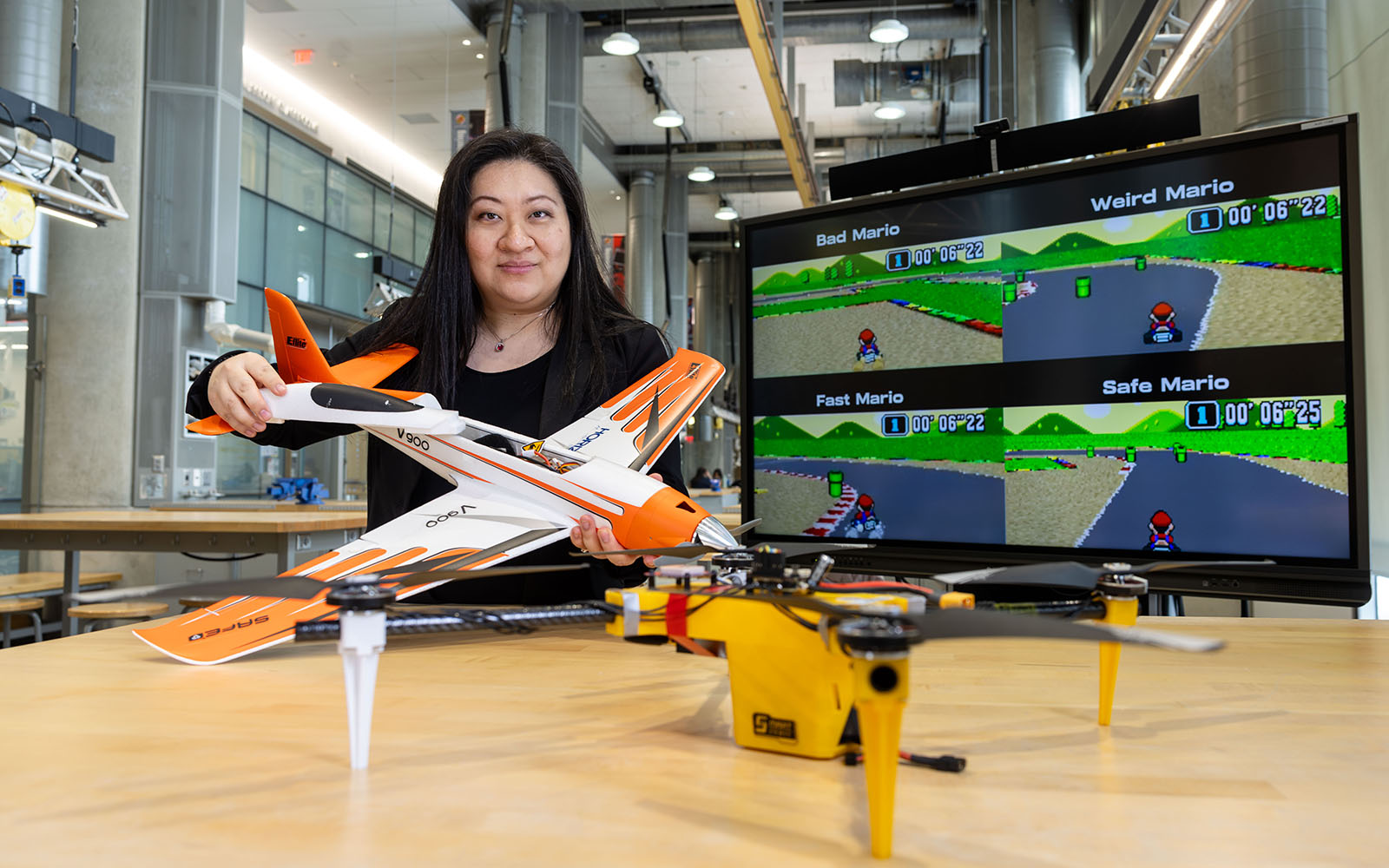
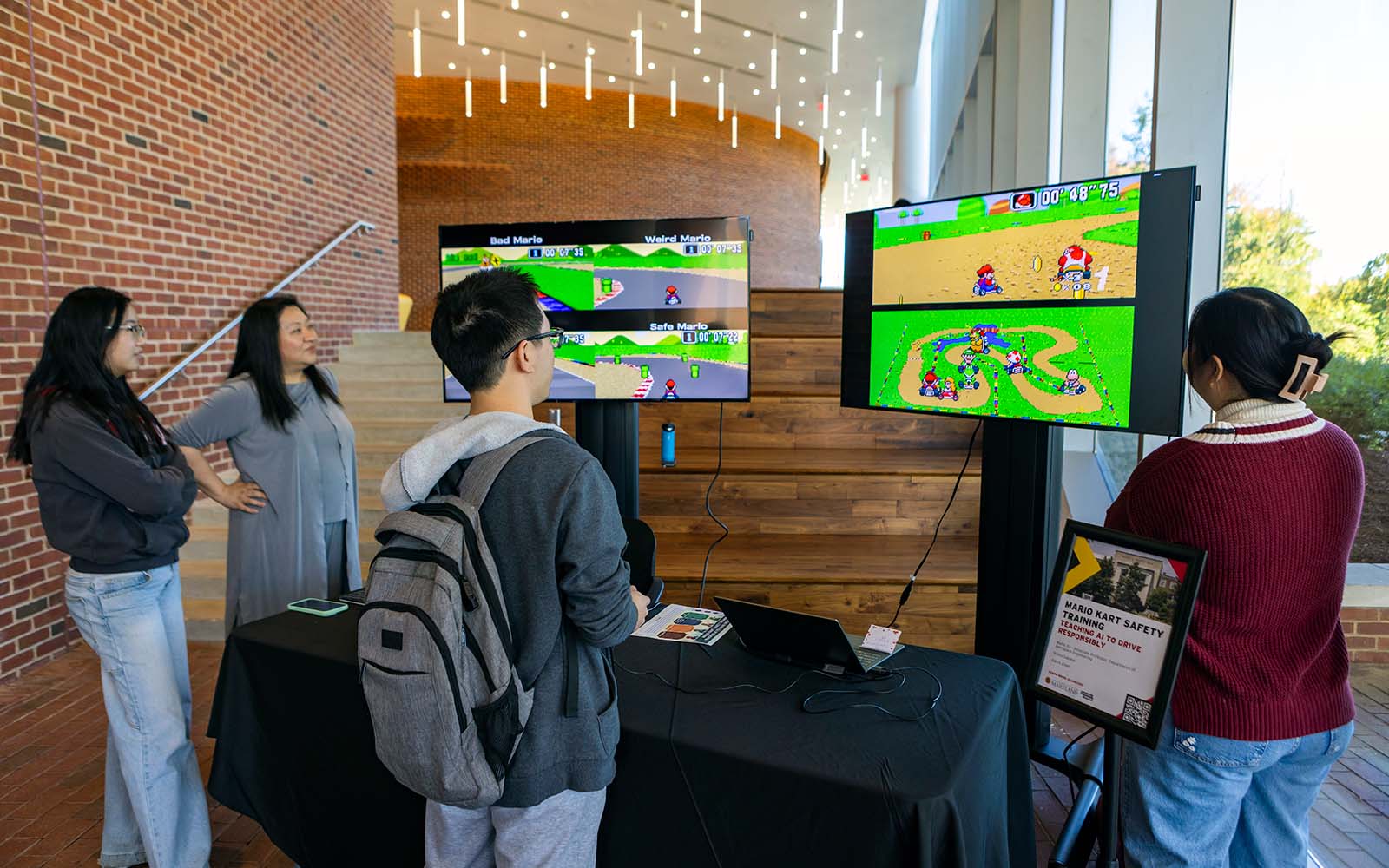
Xu is working to fill that gap with a process that relies on the classic Nintendo game Mario Kart. Her team downloaded an online version of the game and trained a computer to play it, using reinforcement learning: They augmented the code with a reward structure—a set of “if-then” statements—to grant Mario points for finishing a lap and not hitting the wall.
From bad to weird and from fast to safe: Xu’s AI-trained driver stays on the track and dodges all obstacles.
Over time, after trying different actions and learning how to maximize its reward, the computer’s driving behavior improved. Xu then extracted the map of Mario’s driving path and speed and verified whether it met the standards she had set, effectively evaluating whether the computer had learned to drive safely.
Mario Kart helps reveal real-life safety concerns
The video game is the perfect tool for developing a safety-testing process, because it’s a simple analog for the simulators that will be used to test actual vehicles. Xu’s research is funded by the Naval Air Warfare Center Aircraft Division, which may apply the basic process she’s developed with its own higher-fidelity simulators. She anticipates that regulatory agencies for autonomous vehicles will develop a similar process for testing vehicle safety.
Xu’s Mario Kart simulations start broader conversations on training AI models to enhance safety across industries.
After the vehicles’ software has been tested for safe driving in simulation, regulators would analyze the outputs—just as Xu is evaluating Mario’s driving record—to determine whether the vehicle is operating safely. If the software performed well in simulation, it would then be tested in a real car.
Benefits beyond the transportation industry
Xu’s work also could be applied to biomedical devices with AI components, such as surgery tools with computer vision sensors: The tools could be tested in simulation, and evaluators could review the outputs and adjust them to improve safety.