Maryland engineers are rethinking the technologies that shape everyday life. Their work aims to make essential systems cleaner, more efficient, and less costly—whether powering data centers, moving goods to market, or keeping us connected in the air and on the road.
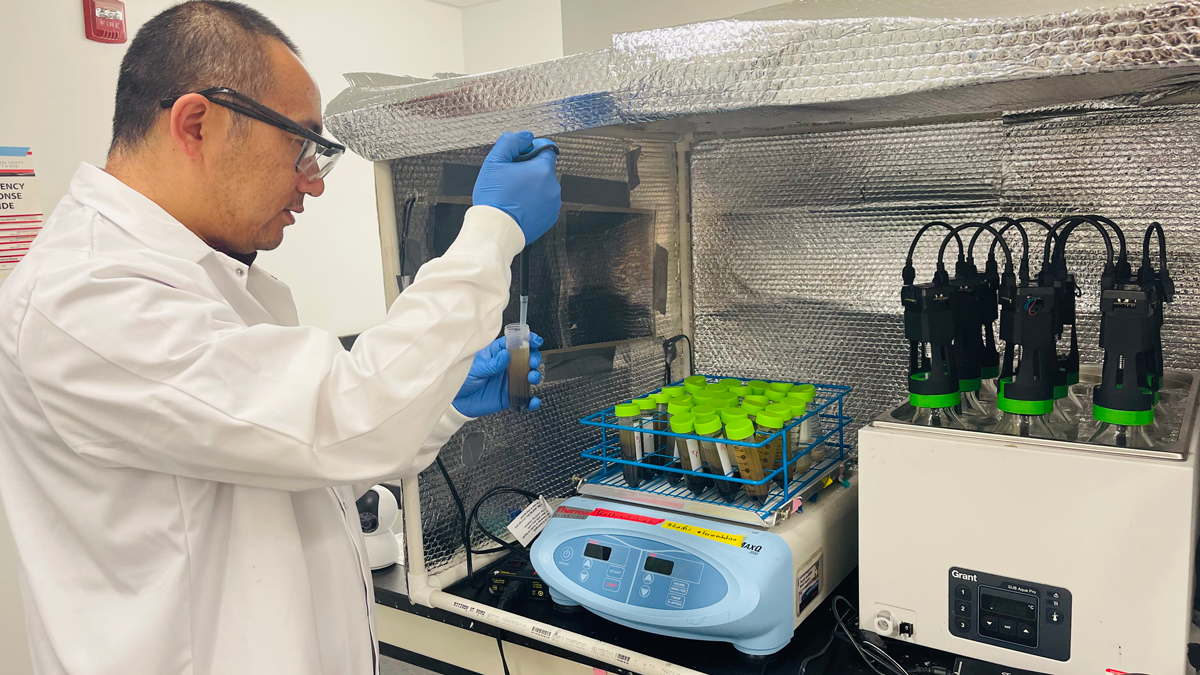
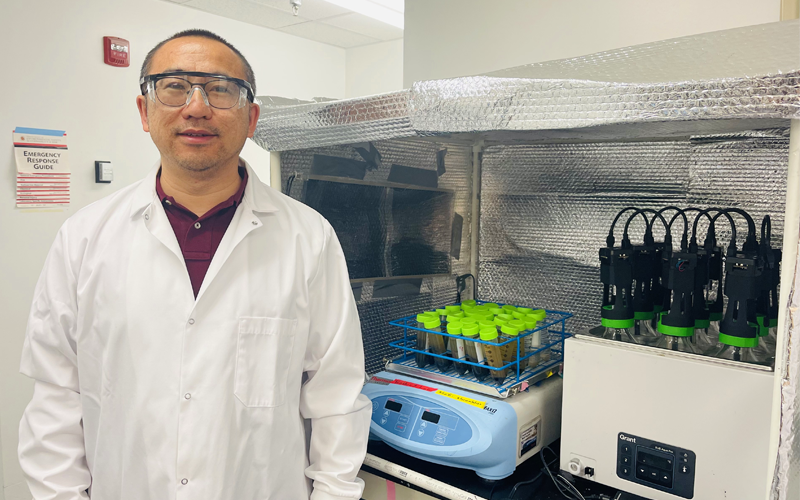
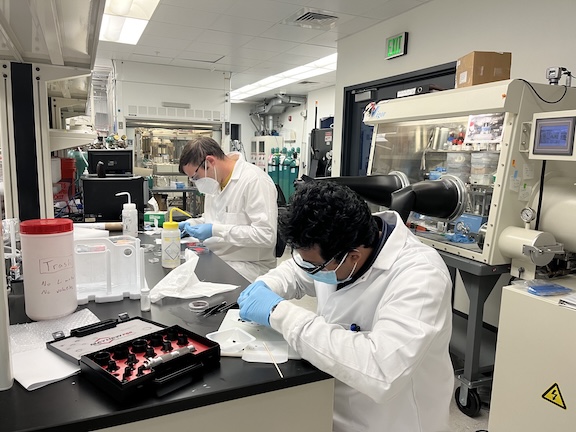
Professor Guangbin Li conducts biological methane potential experiments in the Nutrient-Energy-Sustainability Lab. (Photo courtesy: Guangbin Li)
Story by Wynne Parry | lllustrations by Denis Freitas
To move society forward, we need to improve the systems that serve us. Maryland engineers are hard at work developing cleaner, less costly, less resource-intensive technologies to meet our fundamental needs — in grocery stores and data centers, in the air and on the roads.
Here’s how our work could upgrade three crucial sectors:
Rotten food releases molecules that waft into your nose, provoking your brain to issue a warning: Don’t eat that.
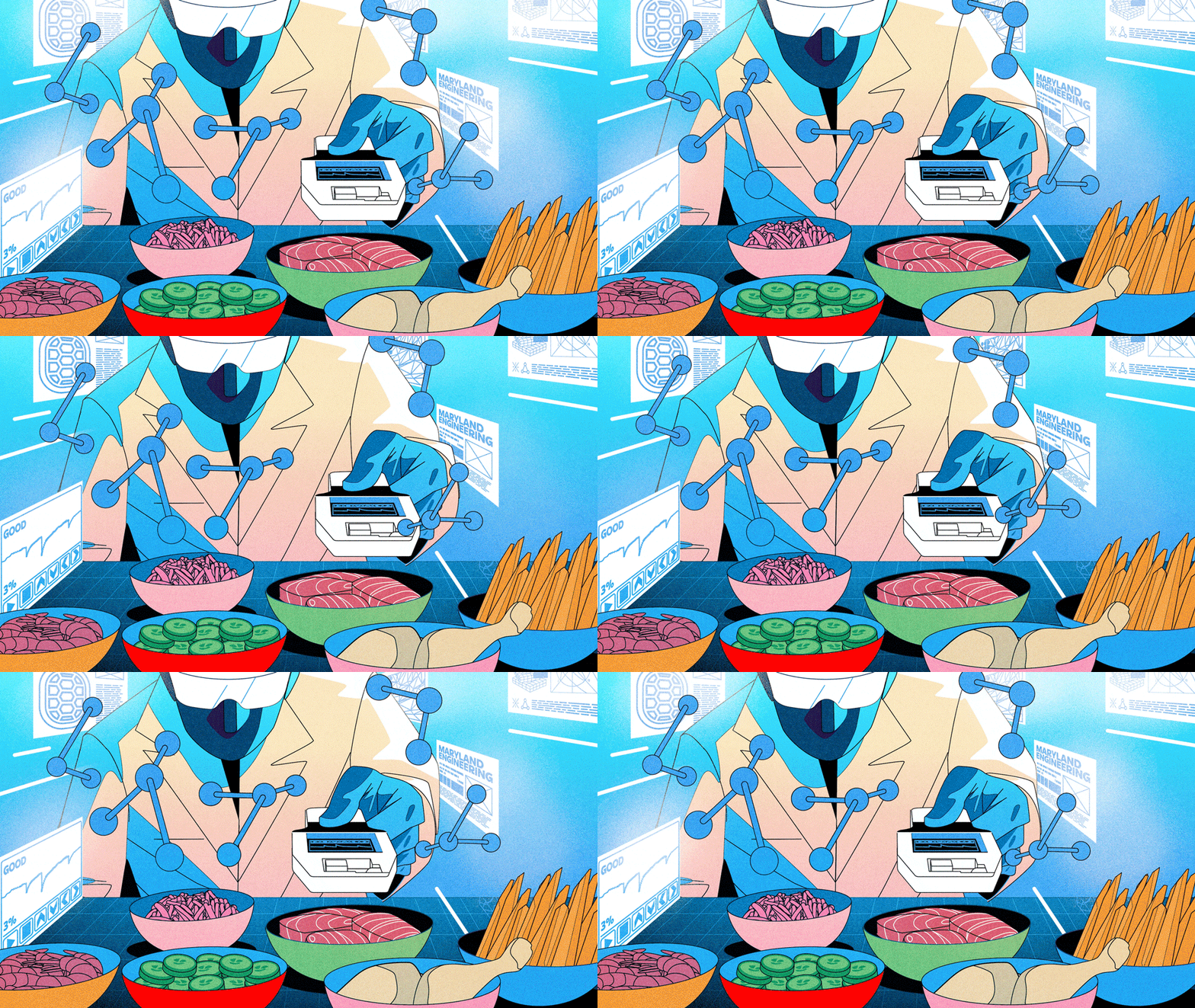
Cheng Gong, associate professor of electrical and computer engineering, and his team are harnessing that molecular warning system to develop technology that can detect the scent signature of spoilage — and with greater sensitivity than the human nose.
Quantum Nose device prototype. (Photo courtesy: Cheng Gong)
While human smell depends on receptor proteins, Gong’s sensing device relies on a layer of graphene so thin, it measures only a single carbon atom thick. Gas molecules interact with the graphene at the subatomic (or quantum) scale, absorbing or transferring individual electrons to produce an electrical signal.
“In a well-controlled experiment in a vacuum chamber, if you introduce just a single molecule, this device can sense the change in graphene’s conductivity,” Gong says of his team’s ‘quantum nose’, which took home UMD’s Invention of the Year top prize in 2022. They are employing advanced data analysis to ensure the device responds only to molecules emitted by spoiled food. The work is supported by a National Science Foundation Convergence Accelerator Phase 2 award.
Gong anticipates that the quantum nose could be used to test the freshness, or spoilage, of any odor-emitting food. He envisions it deployed in factories, grocery stores, and storage facilities (consumers will likely continue to rely on their own noses for a while, he says).
At these facilities, the quantum nose could more reliably assess large quantities of food than conventional approaches, such as “sell by” dates — improving safety while also keeping good food, which might otherwise be discarded, on the shelves.
Gong ultimately hopes to use the devices as part of a broader effort to get people to reconsider what they eat and what they throw out, potentially reducing waste. “There is an educational component to this tool,” he says.
The Food Waste Paradox
Americans threw away an estimated 66.2 million tons of food in 2019.
Yet, about 10.5 percent of U.S. households lacked adequate access to food at some point during that year.
Smarter Packaging: Storing Food Longer (With Help from AI and Robotics)
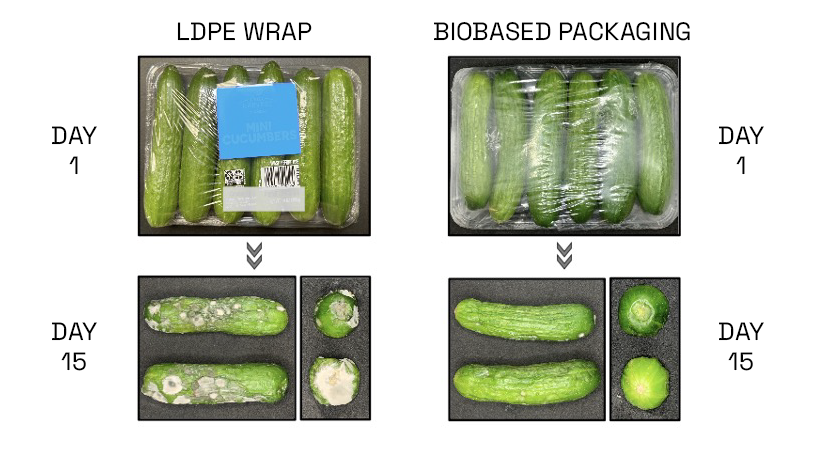
Side-by-side comparison of cucumbers after 15 days wrapped in conventional plastic versus Chen and colleague's bio-based packaging. (Image courtesy: Po-Yen Chen)
The clear plastic that covers cucumbers in the grocery store keeps them fresh and crunchy longer. But once its job is done, this lightweight, petroleum-based film can turn from protector into pollutant, joining other slow-to-degrade plastic waste.
Po-Yen Chen, assistant professor of chemical and biomolecular engineering, and his team are using artificial intelligence (AI) and robotics to identify more environmentally friendly films that do an even better job of preserving fruits and vegetables.
“We are not just looking for alternatives to plastic,” he says. “We want to engineer materials that surpass it in performance and sustainability.”
Finding the best formula for creating a new film, from even a limited set of ingredients, can involve an immense amount of experimentation. Chen and his colleagues have sped up and streamlined this discovery process by automating it.
At first, a specialized robot makes more than a thousand preliminary films, which the team evaluates to narrow their search. An “active learning” AI model then delves deeper into these possibilities by ordering the robot to make additional films. With those data, another model predicts the properties of more than a billion formulations. Using these predictions like a map, researchers can locate the exact formula that meets their criteria.
Compared to conventional plastic wrap, the Maryland team’s chitosan-based film roughly doubles the shelf life of packaged cucumbers. Meanwhile, a second formula based on the plant fiber cellulose lengthens storage of avocados. Unlike plastic, which lingers in the environment, both films disintegrate when exposed to weather, the soil, and its microbes. What’s more, their production (especially that of the cellulose film) produces fewer planet-warming carbon emissions.
The Plastic Problem
A 2017 study estimated that roughly 12,000 million metric tons of plastic could accumulate in landfills and the natural environment by 2050.
Anaerobic Bioreactor: Turning Leftovers into Fuel (and Much More)
From onion skins to orange peels, eggshells to leftover grease, remains of our meals wind up in landfills in massive amounts — taking up space, emitting noxious odors, and creating planet-warming gas.
Professor Guangbin Li conducts biological methane potential experiments in the Nutrient-Energy-Sustainability Lab to assess the biomethane yield of biosolids from water resource recovery facilities. (Photo courtesy: Guangbin Li)
“Food waste is generated every moment, and it’s increasing because the population is increasing,” says Guangbin Li, assistant professor of civil and environmental engineering. “But with an engineering mindset, we can take advantage of it.”
Li and his team want to bring new life to our leftovers by adapting a process known as anaerobic digestion, in which microbes break down biological waste — for example, sewage sludge or animal manure — to meet the particular challenge of food waste.
Some key changes involve taking products of the digestion and putting them back into the process, making it less expensive and more sustainable. For example, they extract liquid from the material being digested and, through a simple conversion process, derive chemicals used to pretreat digestion-resistant components, such as banana peels or peach pits, so the microbes can break them down more readily. They also feed another product, activated carbon, back into the reactor to protect microbial communities from compounds that inhibit their activity and to increase the yield of useful substances.
Like some conventional digestion reactors, the Maryland team’s will produce a mixture composed primarily of methane that can be converted into natural gas. By finely controlling the chemical reactions, they plan to produce other specific compounds, such as raw materials for bio-plastics and other products.
Drawing on support from the Department of Energy, Li and his team have begun working with the Washington Suburban Sanitary Commission’s Piscataway’s Bioenergy Project to build their first reactor. At first, this pilot reactor would process only solids derived from wastewater, but Li hopes to one day accept food waste.
While wastewater plants already use anaerobic digestion, they are reluctant to process leftover food, according to Li: “If we can prove our technology is strong enough and generates high-quality products, then why not? Because they would be solving a problem, and it helps everybody.”
Saving Landfill Space
Nearly 60 percent of discarded food went into landfills in 2019, accounting for more municipal solid waste than any other material, according to the Environmental Protection Agency.
Better Ways to Cool
Replacing Refrigerants: Harnessing Mechanical Stress to Lower Temperatures
Taking refuge from summer heat and keeping our food fresh come with a cost. Whether in buildings or refrigerators, conventional cooling systems need a lot of energy to run and rely on chemicals known as hydrofluorocarbons (HFCs). When they leak into the atmosphere, HFCs trap heat, exacerbating climate change.
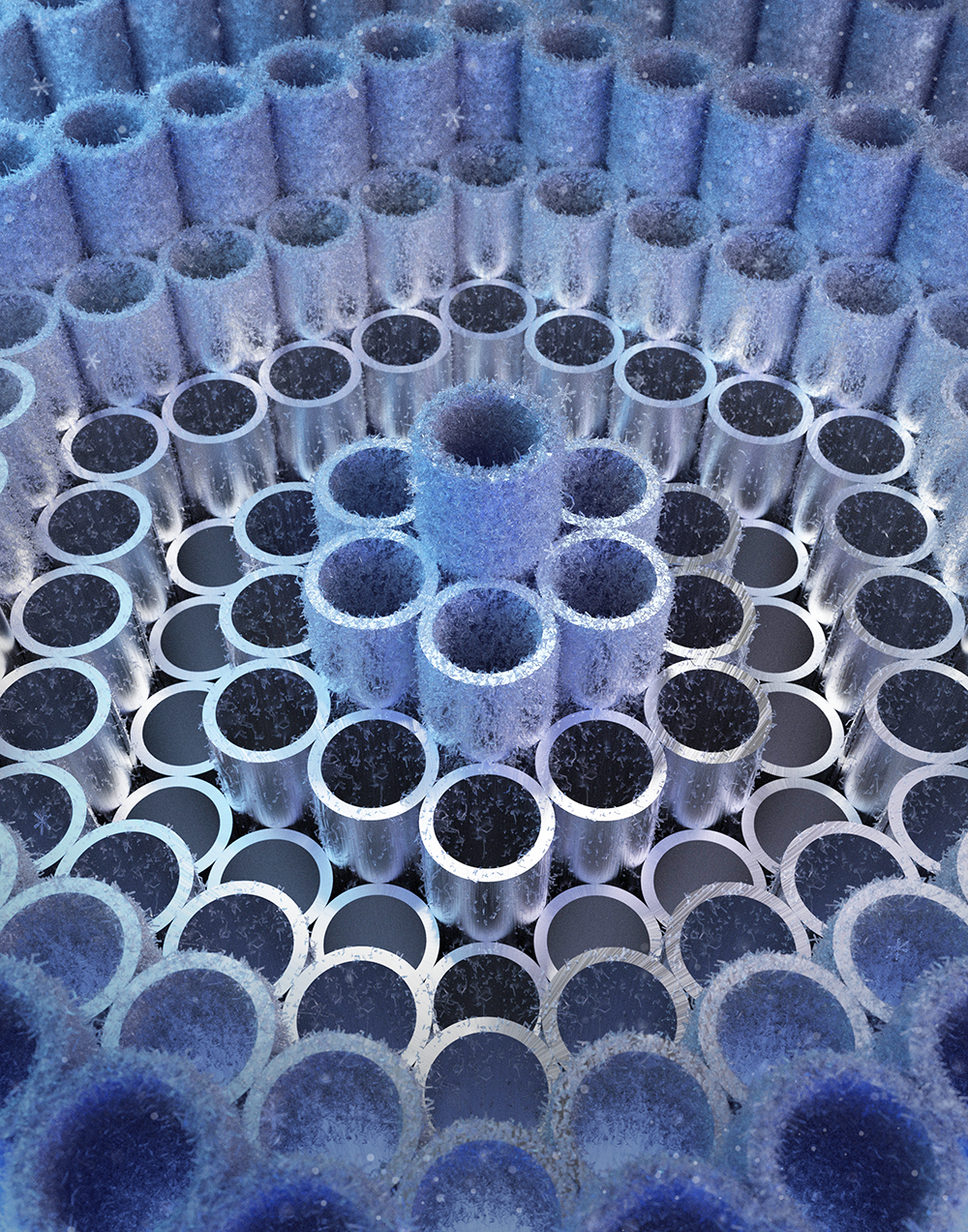
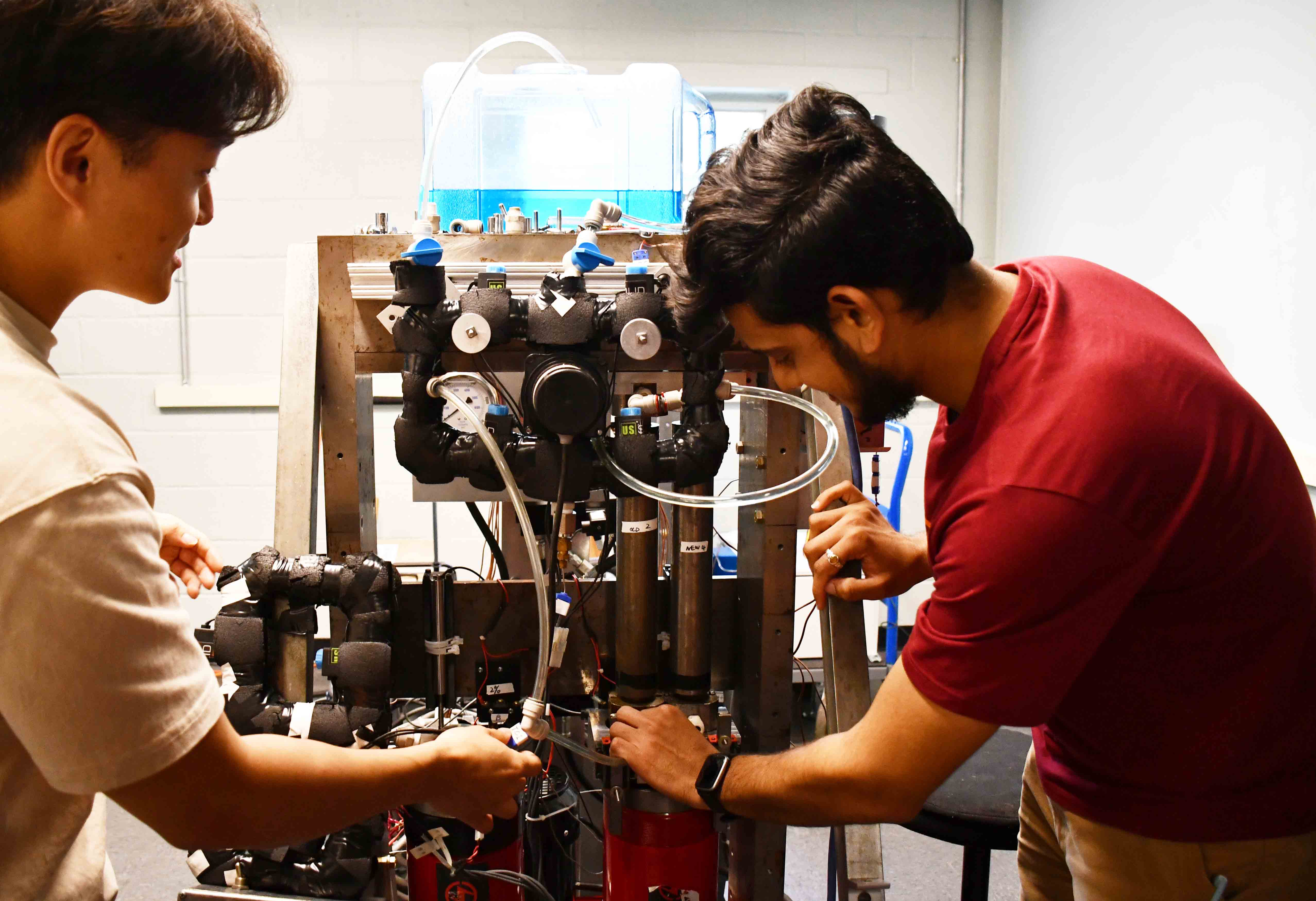
These NiTi tubes heat and cool water as they compress and expand—frost forms when they’re actively cooling, showing their potential for next-gen refrigeration and air conditioning. (Photo courtesy: Jiaqi Dai)
Maryland engineers are working on an alternative — cooling technology that depends on applying stress to straw-like tubes made of nitinol, a nickel-titanium alloy. When bent or deformed in some way, this metal can reconfigure itself into its original shape when heated. This shape-memory feature has made it useful in medical implants and construction.
About 15 years ago, a team that included the late Reinhard Radermacher uncovered something new while working with nitinol: “It turns out you can use it in a reverse way,” says Ichiro Takeuchi, professor and chair of the materials science and engineering department. “In returning to its shape, the nitinol absorbs heat, causing the temperature around it to drop.”
To take advantage of this cooling effect, Takeuchi and Yunho Hwang, a research professor of mechanical engineering affiliated with the Center for Environmental Energy Engineering, are developing a system that cyclically compresses and releases nitinol. Water flows through nitinol tubes, picking up the alloy’s temperature as it travels. Depending on the state of the metal, the water either delivers cooling where it’s needed, or removes stress-induced heat.
While this system will still require power, nitinol’s properties suggest that it could use substantially less energy to provide cooling, according to Hwang. He and Takeuchi are developing this technology through the EARTH Engineering Research Center, which is supported by the National Science Foundation.
Nitinol cooling may offer another advantage, too: “We could use mechanical energy that would otherwise go to waste,” Hwang explains. He envisions harnessing the pressure of cars waiting at an intersection to cool the interior of a toll booth, or harnessing the strain experienced by a train moving over joints in the railroad to lower the temperature within its cars.
Trendsetting Innovation
The journal Nature identified Maryland’s sustainable cooling with nitinol, as seen in this video by Matt Ferrell, among the top innovative technologies to watch in 2025.
Conditioning Data Centers: New Ways to Keep Advanced Processors Running
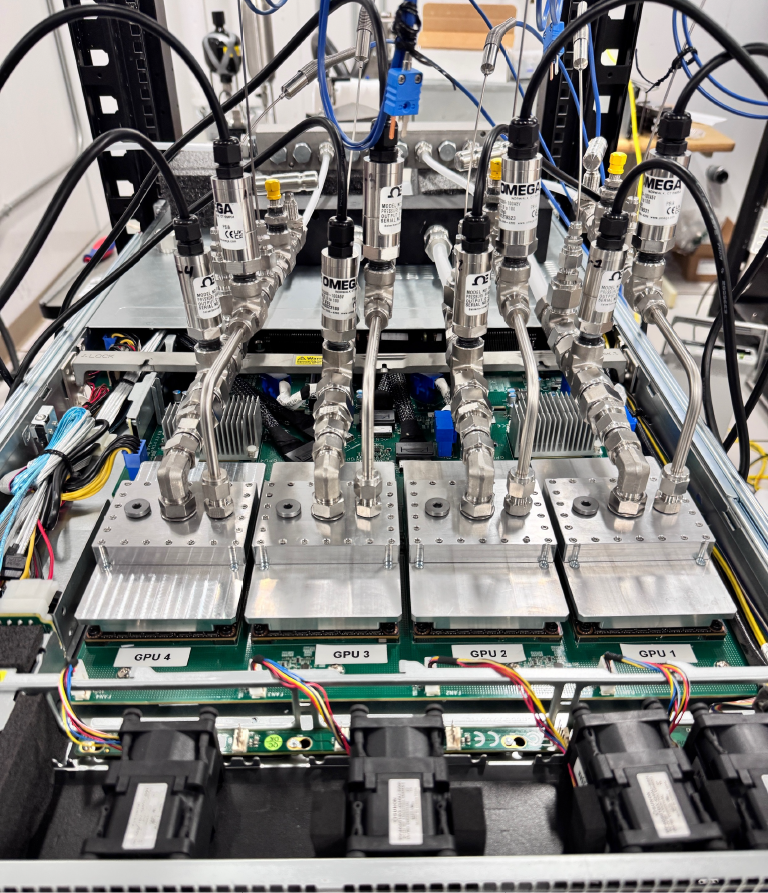
Four direct-to-chip-evaporative (DCEC) cooling cold plates cooling 4 Nvidia V100 GPUs in a Supermicro server simultaneously. The GPUs are stress tested using a computer program to overclock them to their maximum power. This is a benchtop test of the novel cold plates on real compute loads with extensive instrumentation, which will help us understand the thermal-hydraulic performance. (Photo courtesy: Damena Agonafer)
Modern life depends on data centers, where information is stored and processed by electrical signals passing through transistors on computer chips. This electrical activity — which powers AI searches, your email account, financial transactions, and so much more — requires just the right conditions.
Heat produced by ever-more transistors packed onto chips can shut down or damage these electronics. However, conventional cooling techniques are being stretched to their limits, raising concerns about rising demands for water and power.
“We don’t have the technologies we need to cool the next generation of high-powered processors necessary for new AI and other advanced applications,” says Damena Agonafer, associate professor of mechanical engineering and Maryland site lead for the refrigerant-focused EARTH Engineering Research Center.
One of the solutions he is exploring works on the same principle as the human body’s primary cooling system — sweat. Just as the evaporation of sweat absorbs heat and lowers temperature, the evaporation of liquid can cool electronics.
Because water can damage electronics, engineers have turned to dielectric fluids. However, the physical properties of dielectric fluids make them more difficult to control. As a postdoc, Agonafer discovered a potential solution from insects called springtails. Springtails, which live in damp soil and breathe through their skin, rely on tiny compartments lined with sharp edges to prevent water from spreading across their skin and suffocating them. Agonafer and his colleagues, including Ph.D. students Kidus Guye and Vivek Manepalli, have developed an evaporative cooling system that incorporates similar features to keep dielectric fluids contained within the openings of a membrane.
In another project, Agonafer and others at EARTH are contributing to a project that seeks to harness the heat from processors as part of an energy-efficient system for controlling humidity, another essential aspect of protecting electronics. A specialized membrane would passively absorb water from the air; the waste heat would be used to release the water, so the membrane could be reused.
These experimental technologies could prove just as valuable in homes and offices, electric vehicles, industry, and food storage, according to Agonafer: “It’s amazing how much we need cooling and cooling technology, yet how much we don’t really think about it.”
Heavy Water Use
U.S. data centers could use as much as four times more water in 2028 as they did in 2023, according to a report by Lawrence Berkeley National Laboratory.
Improving Travel and Transport
Higher Energy Batteries: Long-Lasting Electrical Power for Trains and Ships
Supported by the Department of Energy’s Propel 1K Program, Maryland engineers are working on rechargeable high-energy batteries that could transform rail and maritime transportation.
Lithium-ion batteries can keep electric cars and trucks on the road, but they don’t store enough energy to be practical for widespread use by other forms of transportation like freight ships or passenger trains. Sustaining larger vehicles on long runs across water and rail requires new battery chemistry.
Paul Albertus, associate professor of chemical and biomolecular engineering and associate director of the Maryland Energy Innovation Institute, and his colleagues are working on such a solution. Funded through the Department of Energy’s Propel 1K Program, the high-energy batteries they are developing could one day help wean the nation’s railways and maritime industry off diesel and other fossil fuels, replacing them with electricity, a cleaner form of energy that can be obtained from many sources, including renewables.
The batteries are built with two substances — graphite and a lithium-halide salt — at the device’s positive terminal, or cathode. This chemistry increases the energy the battery can store relative to its size and weight. The team draws on the expertise of Albertus’ collaborator, Chunsheng Wang, Distinguished University Professor of chemical and biomolecular engineering, a researcher and inventor who specializes in halide cathodes and other battery chemistries.
Batteries with a variant of lithium-halide cathodes are already used in pacemakers, E-ZPass transponders, and elsewhere. But these power sources have a major drawback: They cannot be recharged. The Maryland team hopes to fix this problem by adapting the charge storage mechanism employed by conventional lithium-ion batteries.
“Finding the right chemical mechanism is very challenging and scientifically interesting,” Albertus says, noting that “if we’re able to get a working rechargeable, high-energy battery, it'll find many applications.”
Time for Change
In 2020, the U.S. Department of Transportation estimated that global marine shipping consumed 87 billion gallons of fossil fuel annually. While new, cleaner technologies are being adopted for passenger vehicles, nearly all freight transportation currently runs on fossil fuels. Without action, maritime transport will account for 17 percent of carbon dioxide emissions by 2050, according to a 2015 report commissioned by the European Parliament.
More Reliable Hydrogen Stations: Making An Emerging Fuel an Everyday Convenience
Now appearing on roads in California are cars powered by a new, clean technology: electricity-generating fuel cells that consume hydrogen. Unlike their gas-powered counterparts, hydrogen vehicles emit nothing but heat and water, and they can travel just as far on a full tank.
Professor Katrina Groth and her team are working to improve the reliability and availability of first-of-a-kind hydrogen fueling infrastructure. (Photo courtesy: Katrina Groth)
While California is the only state so far with a network of hydrogen refueling stations, the station equipment often breaks down, forcing drivers to wait up to an hour to fill their hydrogen tanks, according to Katrina Groth, professor of mechanical engineering and associate director of the Center for Risk and Reliability.
“It’s hard to keep a system running reliably when it’s a first-of-a-kind product using all new equipment with limited reliability testing,” Groth says. “Industry is learning as they go, and we want to accelerate this learning.” Making things more complicated, she notes, are the storage requirements of the hydrogen, which is kept as a liquid at a beyond-frigid temperature of about -250 degrees Celsius (-418 degrees Fahrenheit).
Groth and her students are analyzing refueling stations to identify what can go wrong, the likelihood of problems, and their consequences. With this information, they can make strategic recommendations for improving both the equipment’s reliability and the amount of time stations are available for refueling.
In addition to offering this advice, her team collects data on the stations’ components that can inform companies’ decisions about the equipment; Groth and her students also draw on their observations to help establish safety standards and codes.
“We want people who are building these stations in the future to learn from those best practices,” she says.
Student Impact
Often, a hydrogen refueling station goes down because a single, critical component malfunctions. Lauren Reising, a master’s student in Professor Katrina Groth’s research group, focuses on understanding what can go wrong with one such part: the cryogenic pumps that move cold, liquid hydrogen out of storage tanks.
Reising examines data on operation and maintenance of these pumps and the impact on the entire fueling system. This information feeds into a database that she and other reliability engineers use to understand and address component failures like these. “After working behind the scenes, I see how robust these analyses are,” she says. “They give me confidence in the future of hydrogen fuel.”
Out of This World
Hydrogen powers more than cars: It propels rockets out of Earth’s gravity, too. As an undergraduate at Washington State University, Reising’s interest in space eventually led her to study hydrogen at Maryland: “Through my research, I discovered so many other applications of hydrogen that sparked my interest, including its use as a clean fuel.”
Better for the Climate
Adopting hydrogen technology could reduce U.S. greenhouse gas emissions by up to 52 percent by 2030, as compared to 2005 levels, according to the U.S. National Clean Hydrogen Strategy and Roadmap.
Cleaner Skies: Reinventing Jet Engines for Efficiency
Trips to see relatives, attend conferences, and just to have fun burn up a lot of fuel. In 2024, scheduled flights by U.S.-based airlines consumed nearly 12.6 billion gallons of it (at a cost of more than $48.2 billion).
To make flying more efficient, Maryland engineers are looking to overhaul the engines that power some of the largest passenger planes, such as the Boeing 737.
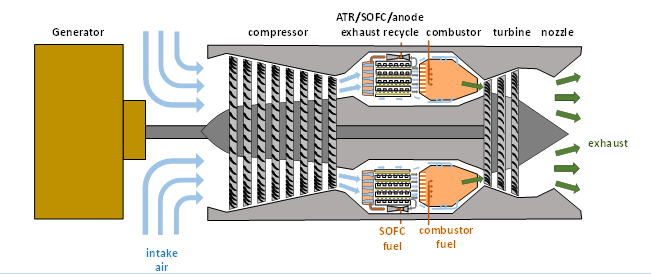
Currently, jet fuel-burning turbine engines, located under the wings, keep these aircraft aloft. Christopher Cadou, professor of aerospace engineering, leads a project with Eric Wachsman, Distinguished University Professor and director of the Maryland Energy Innovation Institute, to develop a new kind of engine that contains both a gas turbine and fuel cells. Instead of generating thrust directly, the engine produces electricity that, in turn, drives more efficient electric propulsion systems. The Colorado School of Mines and the companies Raytheon and Alchemity Inc. are also members of the team.
Professor Christopher Cadou and colleagues are developing turbine–fuel cell hybrid engines to make commercial aviation more efficient and sustainable. (Image courtesy: Christopher Cadou)
The engine will consume liquified natural gas (LNG), a fuel that can be made sustainably and whose energy per unit weight is much closer to that of jet fuel than other renewables when tank weight is taken into account. LNG’s density means engineers don’t need to sacrifice as much of the aircrafts’ payload or range as they would with other renewable fuels.
Putting a turbine and fuel cells together creates a synergistic system that is more efficient than either component by itself while also being light enough to power large aircraft, according to Cadou. More efficient engines ease the transition to renewable fuels by reducing the amount that needs to be made. In doing so, they ease the massive production challenge created by switching to these energy sources.
The project’s funder, the Department of Energy’s ARPA-E program, aims to halve airplanes’ energy usage and accompanying carbon emissions. The turbine-fuel cell engine is expected to achieve about 50 percent of this goal while the remainder will come from the use of electric propulsion.
“We'll know we have been successful if, in 20 years, we will be able to go to the Smithsonian’s Air and Space Museum and see one of these engines with our technology,” Cadou says. “Then we’ll know it’s common, it’s out there.” ┅ M