News Story
Engineers' Work Could Leave Golfers Smiling
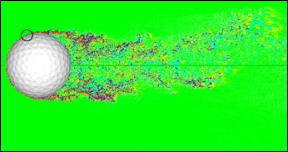
Computer simulation of air flow around a golf ball.
Their results were reported at the 61st Meeting of the American Physical Society's Division of Fluid Dynamics last month.
The team modeled the movement of a golf ball through the air with the highest level of detail ever. This could allow for better design of golf ball dimples, which contribute to the balls' aerodynamics.
Balaras and Beratlis created software for processing equations for the project on parallel supercomputers. This allowed the researchers to perform computations much faster than would have been possible on regular computers.
The researchers' work has received wide coverage in the media, including in the New York Times, among other publications.
Published December 3, 2008
Recent Stories
Stories / May 26, 2026
Apply: Chair of the Fischell Dept of Bioengineering

Stories / Jun 9, 2026
The Future of Terps Racing is Electric

Stories / Jun 8, 2026
Alchemity receives Build our Future Award from Governor Moore

Stories / Jun 8, 2026
Shuna Ni Receives NSF CAREER Award

Stories / Jun 5, 2026
UMD Senior Joshua Mathew Wins 2026 Astronaut Scholarship

Stories / Jun 4, 2026
BIOE Graduate Program Receives Mentoring Excellence Award

Stories / Jun 4, 2026
Risk and Reliability in Space-Based Data Centers
Stories / Jun 3, 2026
Study Shows Dual-Mode “Thermal Battery” Cuts Peak Heating...

Stories / Jun 2, 2026
Wielgosz Receives ARCS MWC Foundation Scholarship

Stories / Jun 2, 2026
Amir Hossein Zabihi Tari Presents at ITherm 2026