News Story
Bergbreiter wins 2008 DARPA Young Faculty Award
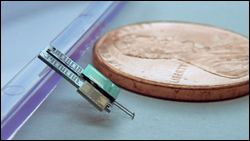
A model of an autonomous jumping robot, with a penny for scale. Photo by Sarah Bergbreiter.
Bergbreiter's research is titled, "Silicon/Elastomer Components for Autonomous Jumping Microrobots."
The research will develop the mechanisms necessary to build a robust autonomous jumping microrobot. Jumping offers numerous benefits to millimeter-sized robots. As the robot size shrinks, obstacles around the robot grow comparatively larger and jumping provides a relatively simple mechanical means of dealing with those obstacles. Ultra low power parasitic locomotion, in which the microrobot uses other objects moving nearby to provide the locomotion power, becomes feasible when the microrobot can jump on and jump off.
For basic functionality, a jumping microrobot benefits from its relative simplicity. It requires only a motor, an energy storage element to store and quickly release mechanical energy for a jump, a controller, and a power supply. However, while the robot itself is fairly simple, the components have performance requirements above those offered by current technologies.
To achieve the performance and robustness necessary to make this vision feasible, microrobot mechanisms such as motors and springs will be fabricated in a silicon/elastomer process. Specifically, this process will add an elastomer like PDMS into a standard SOI MEMS process to improve motor force density and spring performance to the point at which the robot will be able to store and release enough energy to jump 10s of centimeters. The silicon/elastomer process will also add robustness so that the robot will be able to land and jump again.
Published April 1, 2008
Recent Stories
Stories / May 26, 2026
Apply: Chair of the Fischell Dept of Bioengineering

Stories / Jun 9, 2026
The Future of Terps Racing is Electric

Stories / Jun 8, 2026
Alchemity receives Build our Future Award from Governor Moore

Stories / Jun 8, 2026
Shuna Ni Receives NSF CAREER Award

Stories / Jun 5, 2026
UMD Senior Joshua Mathew Wins 2026 Astronaut Scholarship

Stories / Jun 4, 2026
BIOE Graduate Program Receives Mentoring Excellence Award

Stories / Jun 4, 2026
Risk and Reliability in Space-Based Data Centers
Stories / Jun 3, 2026
Study Shows Dual-Mode “Thermal Battery” Cuts Peak Heating...

Stories / Jun 2, 2026
Wielgosz Receives ARCS MWC Foundation Scholarship

Stories / Jun 2, 2026
Amir Hossein Zabihi Tari Presents at ITherm 2026